
Maryland Express Services (MES) — MVA-Authorized Tag & Title
Update: As of October 1, 2026, Maryland no longer requires a notarized bill of sale for these sales. This page is our how-to for the bill of sale itself: what to put on Form VR-181 and how to fill it out. For the news on the law change, see our post on the October 2026 Maryland notarized bill of sale change.
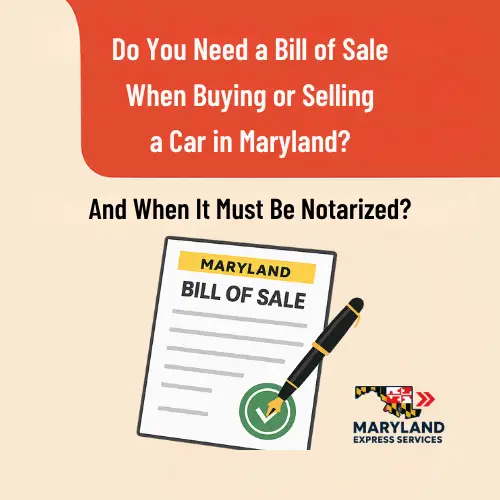
Maryland doesn’t always ask for a Bill of Sale — but when your price is low and the vehicle is newer, the MVA wants proof. Here’s exactly when you need it, what proof the MVA accepts now that notarization isn’t required, and how to check the “book value” the state uses.
Quick Answer: Do You Need a Bill of Sale in Maryland?
Not always. If the vehicle is less than 7 years old and the sale price is more than $500 below the NADA value, the MVA wants documentation that supports your price, and a bill of sale signed by buyer and seller is the most common way to show it. In other sales, the properly assigned title is usually enough, but a signed bill of sale is still smart to keep. As of October 1, 2026, it no longer needs to be notarized.
For the MVA’s own overview, see the official MVA Selling a Vehicle page.
What to Include in a Maryland Bill of Sale (VR-181 Checklist)
The MVA says a bill of sale should include the vehicle information, the sale price, the date, and the buyer’s and seller’s names and signatures. The free MVA Form VR-181 covers all of it:
- Buyer and seller names
- Vehicle details: year, make, model, body style, and VIN
- Odometer reading in whole miles, plus the two “not actual mileage” checkboxes if they apply
- Sale price
- Reason for the price if it is below fair market value
- Date of sale
- Signatures and dates from buyer and seller (the form includes a perjury statement)
How to Fill Out a Maryland Bill of Sale, Step by Step
- Download the free VR-181 form (the revised version no longer has a notary block).
- Enter the vehicle’s year, make, model, body style, and VIN exactly as shown on the title.
- Write the odometer reading in whole miles and check a “not actual mileage” box only if it applies.
- Enter the sale price and, if it is below fair market value, the reason (for example, damage or high mileage).
- Print the buyer’s and seller’s names, then both of you sign and date the form.
- Make a copy for each of you and keep proof of payment with it.
Handwritten or typed is OK. You don’t have to use VR-181. A handwritten or typed bill of sale works too, as long as it has the same information and both signatures.
Need help with your tag or title?
Visit Maryland Express Services in Reisterstown, open 7 days a week. Call, text or WhatsApp (443) 826-7843.
Buying or selling a used car in Maryland comes with a fun little mystery: some people say, “I didn’t need a bill of sale,” and others say, “The MVA sent me back to get it notarized.” Before October 1, 2026, both could be true. Today, Maryland no longer requires a notarized bill of sale for vehicles less than 7 years old sold by a private party, but the MVA may still ask you to prove a low sale price.
This post explains those situations, gives you the official links, and shows you how to keep the MVA from taxing you on more than you actually paid.
When Proof of Your Sale Price Is Required
You’ll need to give the MVA documentation that supports your sale price, such as a bill of sale signed by buyer and seller, if all of the following apply:
- The vehicle is less than 7 years old.
- The sale price is more than $500 below the vehicle’s NADA value (the MVA’s “book value”).
- The buyer wants to pay tax based on the sale price instead of the state’s book value.
That documentation is how you prove to the MVA, “No, we really did sell it for that amount.” Without it, you’ll be taxed on the NADA value instead of your price. Notarization is no longer required. The MVA says there’s no complete list of acceptable evidence, but it gives these examples:
- A bill of sale, or documentation of the vehicle’s condition that supports the price (such as repair estimates or photos of damage)
- Financial records, like a canceled check, a bank statement showing the payment, or loan documents
- The original ad showing the price, or messages between you and the seller discussing the price
- A listing from another national pricing guide, such as Kelley Blue Book or Price Digest
MVA agents may also do their own research to decide on a reasonable price range. If the value is disputed, or the system can’t find a NADA value for your vehicle, the transaction is sent to the MVA for review by an MVA agent.
📄 Want to use the MVA’s form for your bill of sale? Download it here: Maryland MVA Bill of Sale (Form VR-181). You no longer need to have it notarized.
When a Bill of Sale Is Not Usually Required
In a lot of normal private sales, the title alone is enough. That’s usually the case when:
- The vehicle is 7 years old or older; or
- The sale price is within about $500 of the book value.
In those situations, the MVA often accepts the properly assigned title (with sale price, date, buyer/seller info) and doesn’t ask for extra documentation of the price.
But it’s still smart to have one — because it protects both buyer and seller if anything is questioned later.
Selling instead of buying? See what to do after selling a car in Maryland.
Why Proof of Your Price Matters
Maryland charges a 6.5% vehicle excise tax, and they apply it to the higher of:
- the price you say you paid (title or bill of sale), or
- the MVA’s internal “book value.”
If your price is more than $500 below what the state thinks the car is worth, they’re going to want proof. A signed bill of sale, proof of payment, or your messages with the seller can be that proof. It’s the difference between “okay, we’ll use your number” and “we’re going to tax you on the higher value.”
What the MVA Means by “Book Value”
Maryland doesn’t use Kelley Blue Book My Car’s Value to set the value it compares your price to (though a Kelley Blue Book listing is one of the documents that can help support a lower price). The MVA uses the NADA/J.D. Power valuation data — the same stuff dealers and the state look at for average retail pricing.
That’s the number they compare your sale price to. If your price is within $500 of it, taxes are calculated on the price you reported. If you paid more than $500 less than that, you can pay tax on the NADA value or provide documentation that supports your lower price.
You can point customers to the MVA’s own calculator here: MVA Vehicle Excise Tax Calculator
That tool gives a close estimate of the value the MVA will use. If your price is more than $500 below that — and the car is under 7 years — gather documentation that supports your price (see the list above).
MES Tip
When in doubt, document it. Keep a bill of sale signed by both of you, proof of payment, and screenshots of your messages with the seller. It’s cheaper than making another trip or paying tax on the higher value.
Bring your title, bill of sale, and buyer/seller info to Maryland Express Services, and we’ll tell you right away if the MVA is likely to ask for proof of your price.
Need hours or directions? Visit our contact page or call (443) 826-7843.
Frequently asked questions
1. Can I handwrite a bill of sale?
You can. As of October 1, 2026, it doesn’t need to be notarized, and the MVA says there’s no complete list of acceptable documents. A bill of sale is one of the examples it gives. The official Form VR-181 is still a handy template because it has every field they want.
2. Does it have to be notarized?
No. As of October 1, 2026, Maryland no longer requires a notarized bill of sale for vehicles less than 7 years old sold by a private party. If the vehicle is less than 7 years old and the sale price is more than $500 below the NADA value, you can pay tax on the NADA value or provide documentation that supports the lower price. In other cases, a signed bill of sale is just good documentation.
3. What if the title doesn’t show the sale price?
Then use a bill of sale. The MVA needs something that shows the amount. A title with no price + no bill of sale makes the MVA default to their value.
4. What happens if we “lowball” the sale price to save tax?
The MVA will ignore it and use their book value. A realistic price backed by documentation, like a signed bill of sale and proof of payment, is the safest way to go.
5. What’s this 6.5% tax again?
Maryland charges a 6.5% vehicle excise tax on the higher of (a) your sale price or (b) the MVA’s book value. That’s why paperwork matters — it affects what you pay.
6. Do I need a bill of sale to register a car in MD?
Not always. The properly assigned title usually covers a private sale. But if the vehicle is less than 7 years old and the price is more than $500 below the NADA value, you’ll need documentation that supports your price, such as a signed bill of sale, or you’ll pay tax on the NADA value. It’s smart to have one either way.
7. Is VR-181 free?
Yes. Form VR-181 is a free download from the MVA website, and as of October 1, 2026, you don’t need to pay a notary to sign it.
Next Steps
Sources:
- Maryland MVA — SB125/HB251: Repeal of Notarized Bill of Sale Requirement
- Maryland General Assembly — Chapter 119 of 2026 (Senate Bill 125)
- Maryland MVA — Title & Registration Information
- Maryland MVA — FAQs
- Maryland MVA — Fees
- Maryland Excise Titling Tax
Maryland Express Services (MES) — Reisterstown, MD