
If you have ever purchased a vehicle from a dealer in Maryland and were told you need a bill of sale along with the dealer reassignment paperwork, you may have heard this response before:
“The MVA website does not say that.”
And honestly, that is where much of the confusion begins.
Many customers search online and find websites claiming:
“Maryland does not require a bill of sale.”
But that statement is only partially true.
In real-world Maryland title processing — especially dealer reassignment transactions — a bill of sale or written proof of purchase price is often required as part of the transaction documentation.
Understanding the difference between a simple consumer transaction and a dealer reassignment transaction is extremely important.
What Is a Maryland Dealer Reassignment Form?
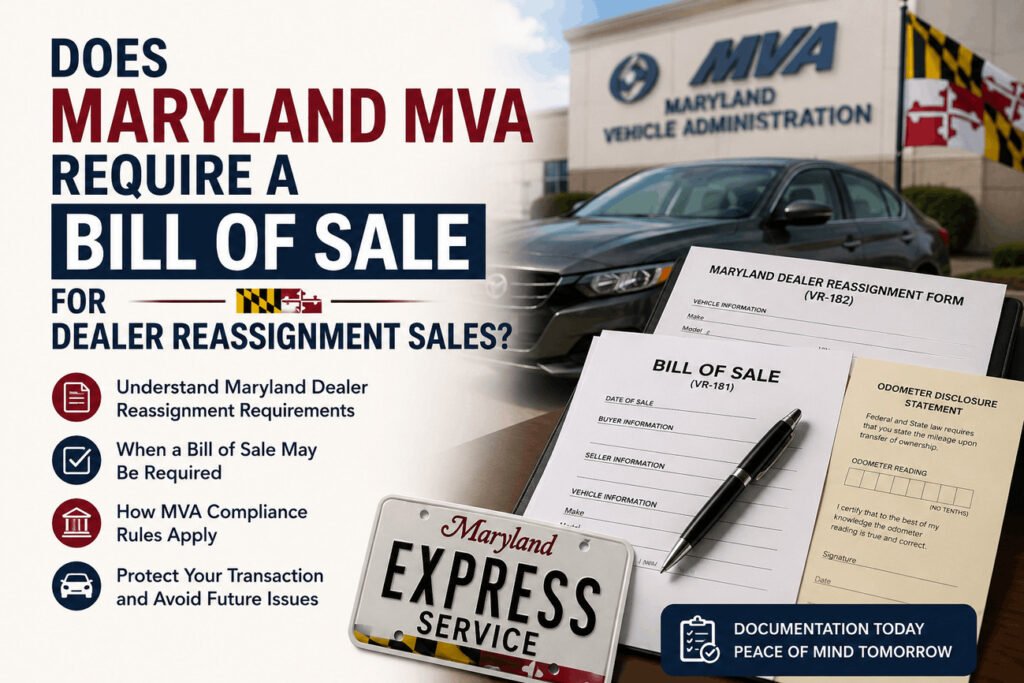
The Maryland Dealer Reassignment Form (VR-182) is used by licensed dealers to transfer ownership of a vehicle when additional assignment space is needed on the title.
The reassignment form is commonly used when:
- A dealer acquires a vehicle from auction
- A dealer transfers a vehicle to another dealer
- Multiple dealer ownership transfers occur
- The title no longer has enough assignment space
- A dealer sells a vehicle to a private retail customer
The reassignment form helps establish the legal ownership chain before the vehicle is titled in the buyer’s name.
However, the reassignment itself is not always enough to fully document the retail sale transaction.
Why Customers Get Confused
The Maryland MVA consumer pages do not clearly state:
“Every dealer reassignment sale requires a bill of sale.”
Because of this, many buyers assume the reassignment alone is sufficient.
But Maryland title processing operates in layers:
- Consumer-facing MVA guidance
- Dealer compliance procedures
- Investigation and audit requirements
- Tax verification requirements
Those layers do not always explain the same thing in the same way.
A front-counter transaction may sometimes process without issue, while an audit or investigation later requests additional supporting documentation.
That is why many licensed dealers and tag & title agencies require a bill of sale as part of their internal compliance procedures.
What the Maryland MVA Actually Says
The Maryland MVA does reference bills of sale and proof of purchase price throughout its titling guidance.
For example, the MVA states that buyers may need:
- “Proof of purchase price”
- “A bill of sale if applicable”
- “Maryland Dealer Reassignment Form, if applicable”
The official Maryland Bill of Sale form (VR-181) also exists specifically to establish the vehicle purchase price.
Additionally, Maryland dealer procedures and COMAR regulations reference dealer bills of sale and written sale documentation in dealer transactions.
In other words:
- the reassignment documents ownership,
- while the bill of sale documents the retail transaction itself.
Those are not always the same thing.
Why Dealers and Tag & Title Agencies Still Require a Bill of Sale
Licensed dealers and title services are responsible for maintaining accurate transaction records.
A bill of sale helps establish:
- Purchase price
- Date of sale
- Buyer and seller information
- Vehicle information
- Tax basis
- Proof of retail transaction
- Protection against title jumping concerns
- Audit and compliance support
This becomes especially important when:
- The vehicle came from auction
- Multiple dealer reassignments exist
- The sale price appears unusually low
- The title is from another state
- The transaction is cash-based
- Temporary tags are issued
- The transaction is reviewed later by MVA Investigation or Compliance
A clean paper trail protects both the buyer and the dealer.
Maryland paperwork has a long memory. A missing document today can become tomorrow’s suspended title file.
Can the MVA Sometimes Process Without a Bill of Sale?
Yes — sometimes.
There are situations where:
- the purchase price is already properly certified,
- all documents are clean,
- and the MVA clerk processes the transaction without requesting additional paperwork.
But that does not mean a bill of sale is unnecessary in every case.
Many experienced dealers and tag & title agencies prefer to require it every time for consistency and compliance protection.
That is why customers may hear different answers depending on:
- which MVA office they visit,
- which clerk processes the transaction,
- or whether the deal is later reviewed by Investigation or Compliance.
Best Practice for Maryland Dealer Reassignment Transactions
For dealer-to-private sales involving reassignment paperwork, the safest practice is to keep:
- Dealer reassignment form (VR-182)
- Bill of sale or buyer’s order
- Odometer disclosure
- Title application
- Insurance information
- Temporary tag paperwork (if applicable)
And most importantly:
all information should match across every document.
Even a small mismatch in:
- sale price,
- buyer name,
- mileage,
- or vehicle information
can create delays or compliance problems later.
Final Thoughts
The internet often oversimplifies Maryland title rules by saying:
“Maryland does not require a bill of sale.”
But dealer reassignment transactions are more complex than a standard private-party sale.
While the Maryland MVA consumer pages may not directly state that every reassignment sale requires a bill of sale, dealer regulations, compliance procedures, and real-world title processing frequently support requiring one.
For that reason, many Maryland dealers and licensed tag & title agencies require a bill of sale as part of their normal transaction process — not to make things harder, but to protect the integrity of the transaction and avoid future issues.
References & Resources
- Maryland MVA – Dealer Reassignment Form (VR-182)
- Maryland MVA – Buying, Selling or Gifting a Vehicle
- Maryland MVA – Titling a Vehicle Bought from a Private Party
- Maryland MVA – Business Services Forms
- Maryland MVA – Bill of Sale (VR-181)
- Maryland Express Services – Maryland Reassignment Form Explained
FAQ Section
Does Maryland require a bill of sale for dealer reassignment transactions?
In many dealer reassignment transactions, Maryland dealers and tag & title agencies may require a bill of sale or purchase price certification to support the title transfer and tax documentation. While the consumer MVA pages may not clearly state this requirement, Maryland dealer regulations and compliance procedures often reference written sale documentation.
What is a Maryland dealer reassignment form?
A Maryland Dealer Reassignment Form (VR-182) is used by licensed dealers to transfer vehicle ownership when additional assignment space is needed beyond the original title.
Is a dealer reassignment form the same as a bill of sale?
No. A dealer reassignment form establishes the ownership chain, while a bill of sale documents the retail sale transaction, including the purchase price and buyer information.
Why do Maryland dealers ask for a bill of sale?
Dealers and tag & title agencies often require a bill of sale to:
- document the purchase price,
- support tax calculations,
- maintain compliance records,
- and help avoid future title or audit issues.
Can the MVA process a dealer reassignment without a bill of sale?
Sometimes. In certain cases, the MVA may process the transaction if the purchase price is properly certified and all paperwork is complete. However, additional documentation may still be requested during audits or compliance reviews.
What documents are usually needed for a Maryland dealer reassignment sale?
Common documents include:
- Dealer reassignment form (VR-182)
- Vehicle title
- Bill of sale or buyer’s order
- Odometer disclosure
- Proof of insurance
- Title application paperwork
- Temporary tag documents if applicable
What happens if the paperwork does not match?
Differences in sale price, mileage, buyer information, or vehicle details can lead to title delays, tax questions, or compliance issues with the Maryland MVA.
Does Maryland MVA have an official bill of sale form?
Yes. Maryland MVA provides the official Bill of Sale form VR-181, which may be used to establish the vehicle purchase price and support title transactions.