
The History of License Plates in America
The Early Days: A Country on the Move
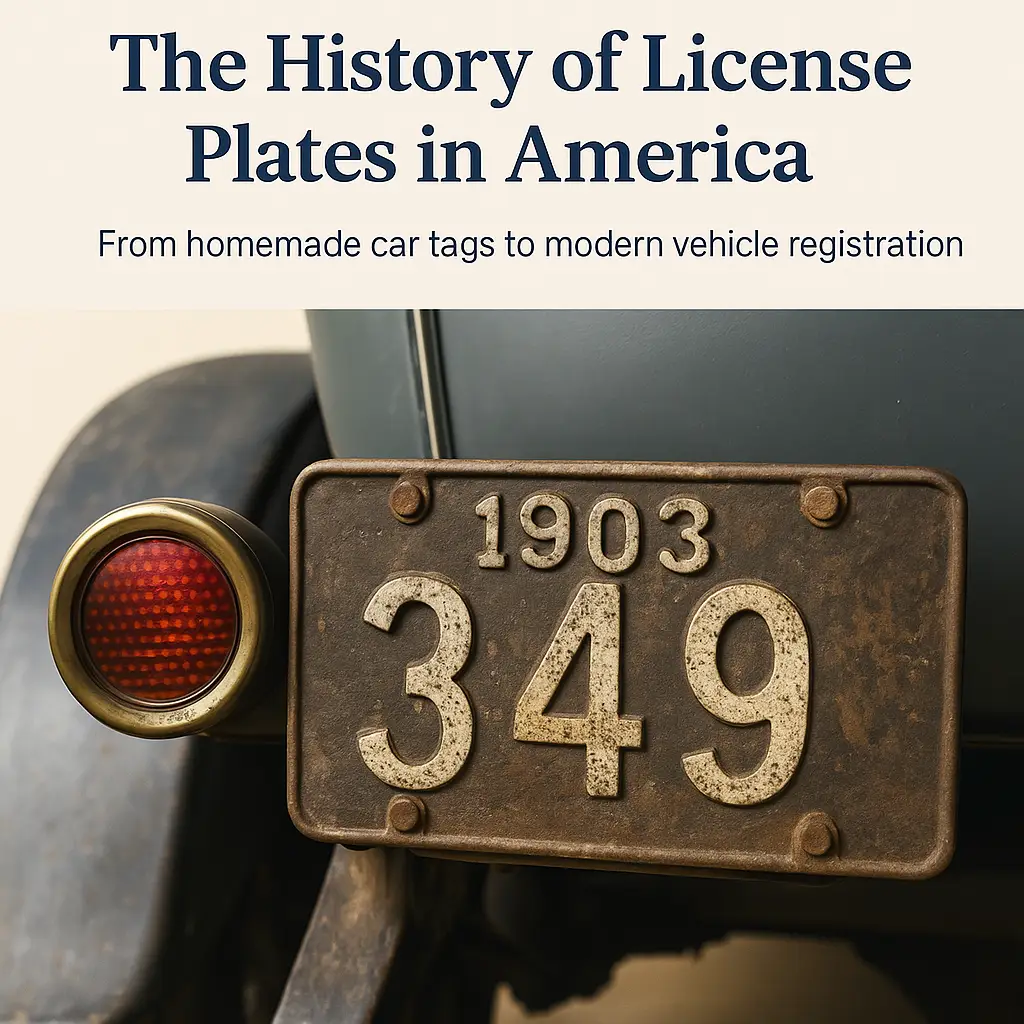
The history of license plates in America begins in the early 1900s, when cars were new, rare, and wild. Many drivers made their own plates from leather, wood, or tin. Each plate displayed initials or hand-painted numbers that identified the vehicle’s owner.
Then, in 1901, New York became the first state to require official vehicle registration. Every car owner had to display an identifying mark. That rule became the spark that started today’s tag and title system.
Just two years later, in 1903, Massachusetts introduced the first government-issued license plate. Made of iron and porcelain enamel, it was stamped with the number “1.” From that point on, order began to replace chaos on the open road.
Titles: Proof of Ownership
By the 1920s, automobiles were no longer rare luxuries — they were part of everyday American life. However, as car ownership grew, so did fraud, theft, and registration disputes. States needed a consistent system to verify vehicle ownership and protect legitimate buyers and sellers.
That’s when the Certificate of Title emerged — a groundbreaking document that officially connected a vehicle to its rightful owner. This title became the cornerstone of modern vehicle registration and remains vital today. Thanks to this system, buying, selling, and transferring cars became safer, more transparent, and far more reliable.
Standardization and the Birth of the DMV
By the mid-20th century, the growing number of vehicles across North America demanded a more standardized registration process. In 1956, the United States, Canada, and Mexico agreed to unify license plate sizes to the familiar 6×12-inch format, a standard later recognized by the U.S. Department of Transportationstill used today.
Soon after, states established Departments of Motor Vehicles (DMVs) — centralized offices responsible for vehicle registration, titling, and driver licensing. This shift marked a turning point in transportation history, bringing structure, accountability, and consistency to what had once been a patchwork of local systems.
Over time, this standardized model created a unified network of regulations that still governs how we register, title, and track vehicles. It was the foundation of the modern tag and title system — the same structure Maryland Express Services (MES) follows today to help drivers stay compliant and confident on the road.
Maryland’s Role in Modern Vehicle Registration
Here in Maryland, progress in vehicle registration and titling took a major leap forward with the creation of the Motor Vehicle Administration (MVA). The MVA became a pioneer in streamlining compliance and registration services, helping drivers complete what once took hours in a matter of minutes.
As technology evolved, Maryland led the way again with the Electronic Registration and Titling (ERT) system — a secure digital platform that allowed MVA-authorized tag and title agents, such as Maryland Express Services (MES), to issue plates, process titles, and handle ownership transfers instantly and accurately.
Today, thanks to Maryland’s forward-thinking approach, residents enjoy one of the most efficient and transparent vehicle registration systems in the country. And through MES, drivers can experience that same convenience locally — without the long MVA lines or delays.
From Paper to Pixels
As technology reshaped daily life, vehicle registration and titling evolved along with it. Many states began adopting digital license plates that can update in real time, display alerts, and even help track stolen vehicles. At the same time, electronic titles (e-titles) started replacing traditional paper documents, making ownership transfers faster and reducing the risk of fraud.
In Maryland, this transition continues to grow under the guidance of the Motor Vehicle Administration (MVA) and its Electronic Registration and Titling (ERT) program. These innovations help tag and title agents like Maryland Express Services (MES) provide drivers with secure, same-day service — all while keeping the process fully compliant with MVA standards.
Even with these modern advances, the goal remains unchanged. Every vehicle still needs a clear identity, verified ownership, and a record that connects the car, the driver, and the state. From paper forms to digital records, the mission stays the same — keeping Maryland’s roads legal, safe, and transparent.
Carrying the Legacy Forward
For more than a century, America’s tag and title system has evolved to keep pace with changing technology and growing demand. From the first hand-painted plates to today’s digital registration tools, each advancement has made vehicle ownership more reliable, efficient, and secure.
At Maryland Express Services (MES), we’re proud to continue that legacy here in Ellicott City as an MVA-authorized Tag & Title Center. Our team combines the precision of Maryland’s Electronic Registration and Titling (ERT) system with the personal attention every customer deserves.
Whether you’re transferring a title, replacing lost tags, or registering a newly purchased vehicle, MES makes it simple, compliant, and fast. The tools may have changed — but our mission remains the same: to keep Maryland drivers legal, safe, and confidently on the road.
Visit Maryland Express Services in Ellicott City — where the history of license plates in America meets the future of vehicle registration.
U.S. Department of Transportation — https://www.transportation.gov
Maryland Motor Vehicle Administration (MVA) — https://mva.maryland.gov
Historical insights adapted from public domain records and state archives on U.S. vehicle registration history.