
One Plate or Two? License Plate Requirements by State (2025)
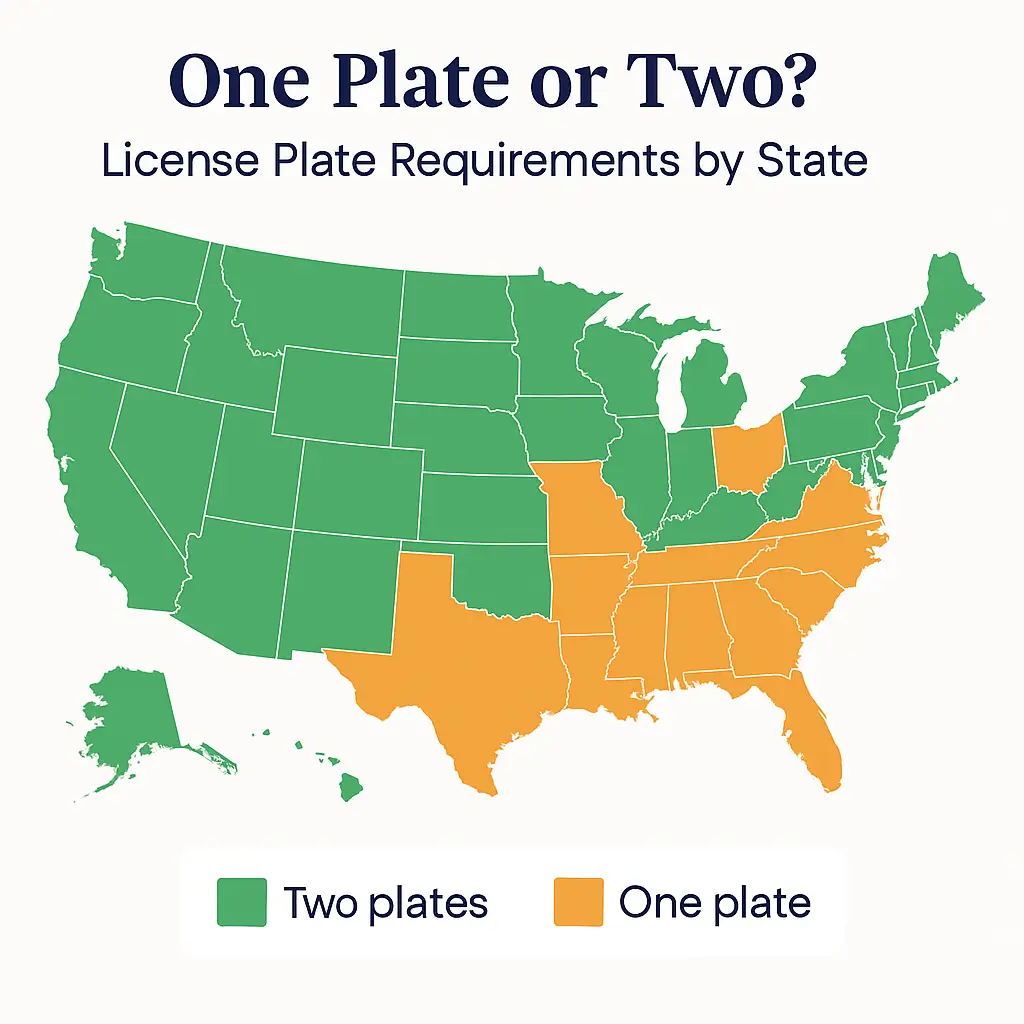
In the United States, license plate rules aren’t one-size-fits-all. Some states require two plates (front and rear) for visibility and enforcement, while others issue a single rear plate to save cost and simplify mounting. Knowing the difference matters when you buy, transfer, or register a vehicle across state lines.
Why States Differ on Plate Counts
Two-plate states emphasize camera readability (tolls, red-light and speed enforcement), witness identification after crashes, and easier plate visibility in traffic. One-plate states point to lower production costs, cleaner vehicle fronts, and fewer installation issues for cars without front brackets.
Two-Plate States (Front & Rear)
Most states require both plates on standard passenger vehicles. Examples include California, New York, Maryland, Washington, Oregon, Illinois, Texas, Virginia, and others. California and New York publicly reinforce the front-plate rule for enforcement and safety, and Texas codifies the two-plate display requirement in statute.
- California: front & rear plates are required for most vehicles (CA DMV guidance).
- New York: front & rear plates are required (see NY law and agency messaging, e.g., NY Thruway Authority notice).
- Texas: two plates required; operating without both plates is an offense (Tx. Transp. Code § 504.943).
- Maryland: see placement rule for vehicles issued two plates (Md. Transp. § 13-411).
One-Plate States (Rear Only)
Several states issue a single rear plate on most passenger vehicles. Long-time rear-only states include Florida and Pennsylvania, among others. Always verify details before you buy or import a car—some vehicles/classes are exceptions.
- Florida: rear plate required; rules and plate types here (FLHSMV plates & registration).
- Pennsylvania: standard passenger vehicles use rear plate only (historical & current notes) (Pennsylvania plate history/summary).
Heads-up (laws change): State plate rules shift over time. For example, recent updates noted that Utah ended its front-plate requirement in 2025, Idaho modified its rule effective July 1, 2025 (front plate required only if a front bracket exists), and Nebraska approved a future change starting in 2029. Always confirm your current state’s law before mounting or transferring. See summary of recent changes.
What Maryland Drivers Should Know
Maryland issues two plates for most passenger vehicles and expects front & rear display in those cases. If you’re transferring a vehicle from a one-plate state (e.g., Florida or Pennsylvania) into Maryland, we’ll confirm your paperwork and plate configuration so your registration goes smoothly.
Need help today? Visit our Tag & Title Services page or contact MES for same-day processing in Ellicott City.
References
- Maryland MVA — Electronic Registration & Titling (context on MD systems)
- Md. Transp. §13-411 — Plate placement (front & rear when two are issued)
- Texas Transportation Code §504.943 — Two plates required
- Florida Highway Safety & Motor Vehicles — Plates & Registration
- DMV.org — State registration & plate rule summaries
- AAA Digest of Motor Laws — State-by-state vehicle law resource
- Vehicle license plates of the United States — recent changes & notes
Article prepared by Maryland Express Services (MES), an MVA-authorized tag & title agent in Ellicott City, Maryland.
Last updated: October 2025. Laws change—always verify your state’s current rules.