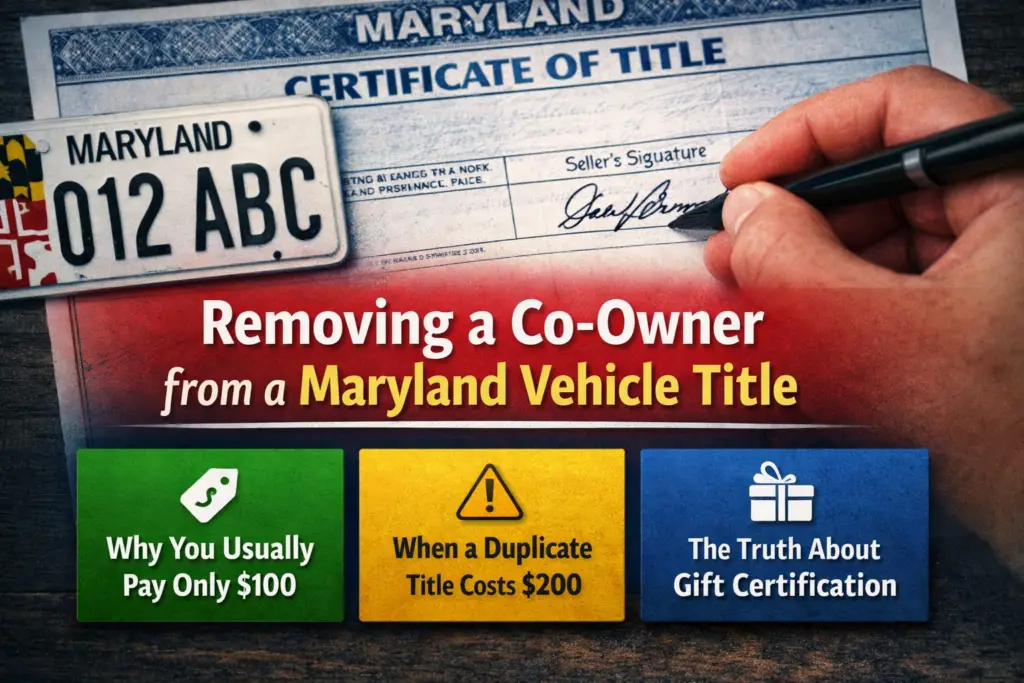

Short answer: to remove a co-owner from a Maryland vehicle title, the owners assign the current title to the remaining owner and submit a new title application (VR-005). The MVA treats this as a title transfer and issues a new title, so the standard MVA title fee applies ($200 for a standard passenger vehicle, plus $40 for a duplicate if the original title is lost). Both owners usually sign; if the departing co-owner can’t sign in person, a Power of Attorney (VR-470) is needed.
Want it done right the first time?
Call, text or WhatsApp (443) 826-7843
Visit us: 25 Main St Suite C, Reisterstown, MD 21136. Open 7 days.
Estimate your MVA feesSee our service fees
Maryland Express Services is a private, third-party agency authorized by the Maryland MVA. We charge service fees in addition to standard Maryland MVA taxes and fees.
Steps at a glance
- Find the original Maryland title (lost? it’s processed with a duplicate, +$40).
- Make sure any lien is released first. See How to remove a lien after payoff.
- All current owners sign to release; the remaining owner signs as buyer.
- Complete the Application for Certificate of Title (VR-005). Do not file a duplicate (VR-018) alone; it can’t change ownership.
- Add a POA (VR-470) only if the departing co-owner can’t sign.
- Check for MVA flags or holds before you go with the MVA Flag Finder.
- Submit and pay the MVA title fee (plus our service fee if we handle it).
What it costs
- MVA title fee: $200 (standard passenger vehicle)
- + $40 MVA duplicate title fee only if the title is missing
- + $40 MVA security interest (lien) filing fee only if a new loan is being recorded on the new title
- 6.5% excise tax (min $41.60) only if no exemption applies, see the FAQ below
- MVA may add a late transfer service fee ($25) if the title application isn’t received within 30 days of the transfer
- No separate “co-owner removal” or per-name fee
- Our service fee is charged on top of MVA fees, see Service Fees
Try the MVA Fee Estimator first.
Fees are subject to confirmation by the Maryland MVA based on submitted documents and transaction type.
Why people expect a lower fee
In Maryland, removing a co-owner is not a correction and not a duplicate. It is a title transfer: the original title is assigned, all current owners sign to release ownership, the remaining owner signs as the buyer, and a new title is issued in the remaining owner’s name. The MVA charges per title issued, not per name removed.
When a missing title adds cost
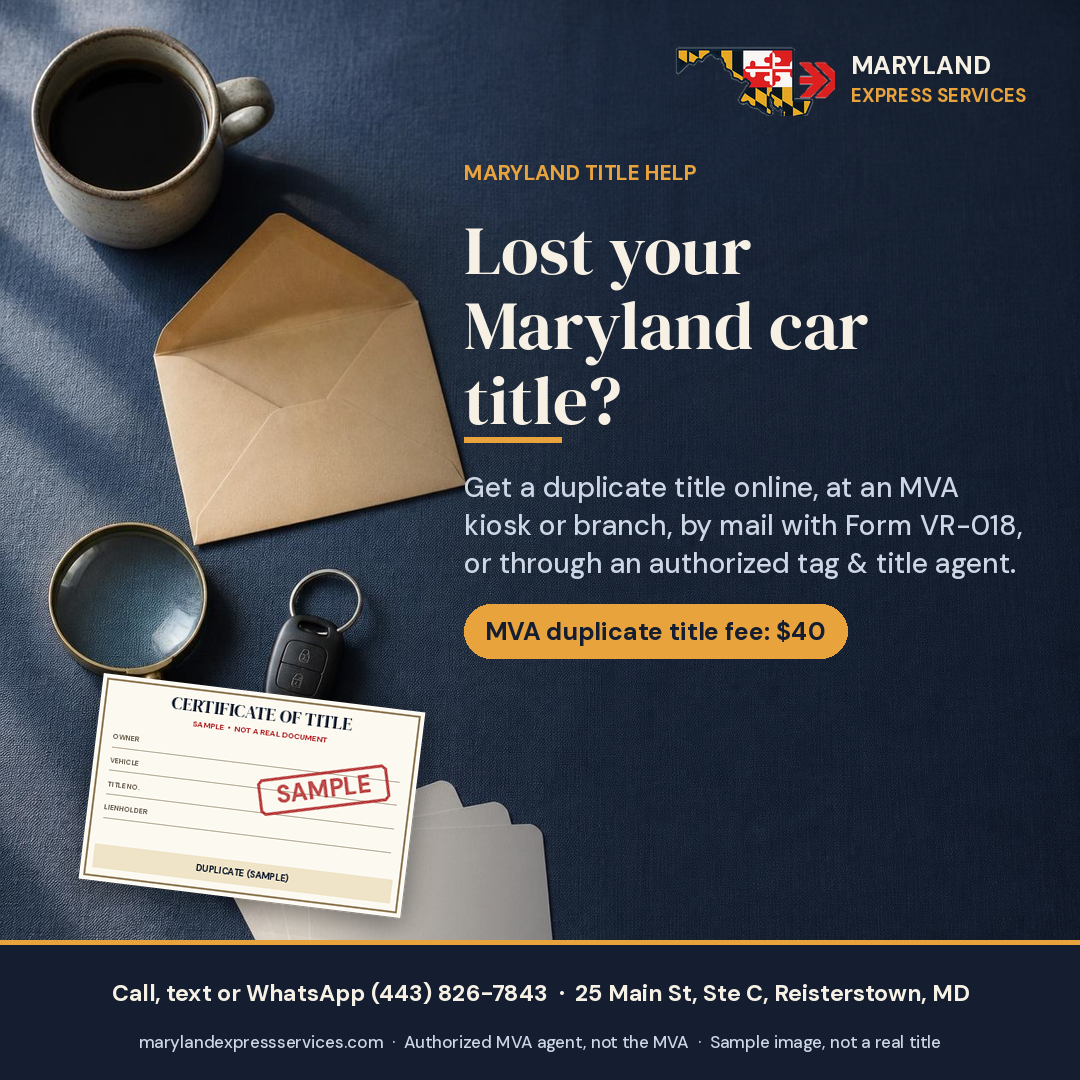
Maryland’s Duplicate Title Application (VR-018) is strictly for lost, destroyed or illegible titles. It cannot change ownership by itself.
What actually happens when the title is missing?
If the original title is unavailable, the MVA processes the request as a new title issuance and a duplicate replacement of the missing title record: $200 (title) + $40 (duplicate) = $240.
Key takeaway
If a name is being removed, don’t treat it like a duplicate-only transaction. Always process it as a full title application (VR-005). Trying to “start with a duplicate” often creates delays, reclassification issues and extra back-and-forth with the MVA.
Do you need a gift form (VR-103)?
If the departing co-owner is a spouse or listed family member and no money changes hands, a Gift Certification (VR-103) supports the excise tax exemption. If they’re not family, the exemption depends on showing the MVA they paid nothing toward the vehicle’s purchase price, taxes or fees. Otherwise 6.5% excise tax may apply.
Why MVA sometimes still asks for a gift form
Even when it shouldn’t be needed, the MVA may request VR-103 if:
- The paperwork is incomplete
- Required signatures are missing
- The transaction was submitted incorrectly (especially as a duplicate first)
In those cases, the reviewer may reinterpret the transaction as a gift transfer to justify the ownership change.
Related guides
- MVA Fee Estimator
- Remove a lien from your Maryland title
- Maryland MVA Flag Finder
- Add someone to a car title in Maryland
- How to gift a car in Maryland
- Duplicate title in Maryland
- Vehicle transfer after death
Frequently asked questions
Do I need a special form to remove a co-owner?
No. Maryland has no “remove co-owner” form. The owners assign the title and submit VR-005.
Is Power of Attorney always required?
No. A POA (VR-470) is needed only if the co-owner being removed can’t sign the title. If both owners sign, no POA is needed.
Can I remove a co-owner using a duplicate title?
No. A duplicate title (VR-018) can’t change ownership. Using one is a common reason transactions are rejected or re-billed.
Why did MVA tell me I owe $200?
Because removing a co-owner means issuing a new title, and the MVA title fee for a standard passenger vehicle is $200. If the original title is lost, a $40 duplicate fee is added.
Is excise tax due when removing a co-owner?
It depends. Maryland law exempts the transfer from the 6.5% excise tax when the vehicle goes to one of the joint owners and the MVA is satisfied that the departing co-owner paid no part of the original purchase price, taxes or fees. It’s also exempt when the departing co-owner is your spouse, parent, child, sibling or other listed family member and no money changes hands, usually documented with a Gift Certification (VR-103). If neither applies, excise tax can be due. (Source: Md. Code, Transportation §13-810(c)(1) and (c)(6).)
What if my co-owner spouse passed away?
The MVA may not charge a title fee for the new title issued to a surviving spouse who was a joint owner. (Transportation §13-802(b)(5).)
Can you handle it for me?
Yes. Call, text or WhatsApp (443) 826-7843 or visit 25 Main St Suite C, Reisterstown. We charge a service fee on top of MVA fees; see Service Fees.
Final advice: do it clean the first time
Removing a co-owner in Maryland is straightforward when done correctly, but small procedural mistakes can trigger extra fees, gift forms or delays. Don’t use VR-018 if ownership is changing, make sure all current owners sign the title, use VR-005 for the new title, and use a POA only when truly needed. If you’re unsure, get guidance before submitting paperwork.
Helpful Resources
- Maryland MVA Titling Information (External): https://mva.maryland.gov/vehicles/Pages/registration/title-registration-info.aspx
- Maryland Title Applications (VR-005): https://mva.maryland.gov/Documents/VR-005.pdf