
Losing a loved one is hard enough. Sorting out what happens to their car shouldn’t make it harder. Maryland lets vehicle owners name a transfer-on-death (TOD) beneficiary on their title, and starting October 1, 2026, that option is open to more families. Here’s a plain-language look at Maryland vehicle transfer-on-death: what changed and how it works.
What is a transfer-on-death designation?
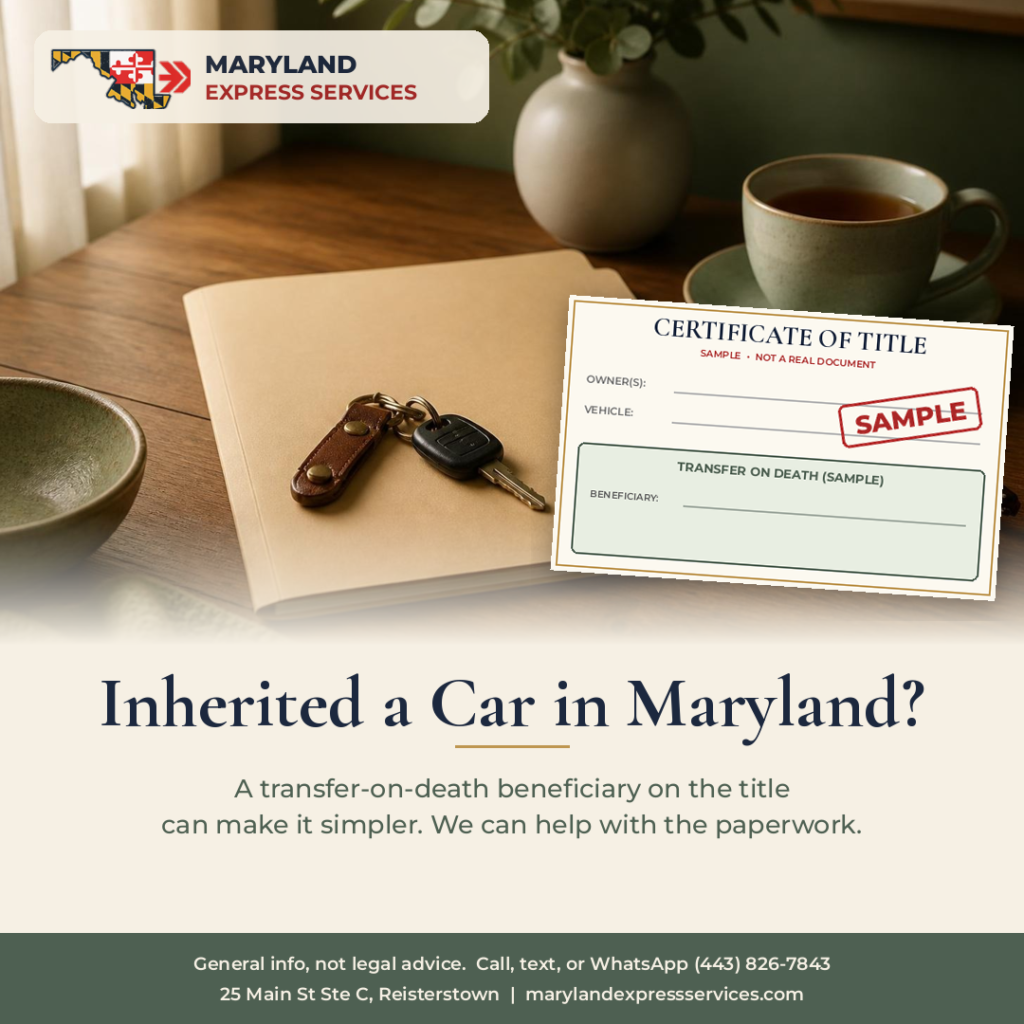
A TOD designation lets you name the person (or business) who will become the owner of your vehicle when you pass away. The designation can appear on the Maryland title as “transfer-on-death” or “TOD” after the owner’s name.
According to the MVA, because the designation is made before the owner’s death, the vehicle is not considered part of the estate, and Letters of Administration are not required for the transfer. For many families, that can make the vehicle much easier to handle after a death.
What changed on October 1, 2026?
Maryland law already allowed a sole owner of a vehicle to name a TOD beneficiary. Senate Bill 145 / House Bill 174 (Chapters 73 and 72 of 2026) expanded the option to vehicles with more than one owner.
Under the new law, people who co-own a vehicle as joint tenants with right of survivorship or as tenants by the entirety can name a beneficiary. The vehicle passes to that beneficiary after the death of the last surviving co-owner.
How your title lists ownership matters. If you’re not sure how your vehicle is titled, bring your title in and we’ll look at it with you. (Changing who is on the title is a different transaction. See our guide to removing a co-owner from a Maryland title.)
The key rules, according to the MVA
From the MVA’s October 1, 2026 legislative update:
- The vehicle must currently be titled in Maryland.
- Only one beneficiary can be named. The beneficiary can be an individual or a business entity.
- Ownership doesn’t change until the death of the last surviving owner. Until then, the vehicle is still fully yours.
- You stay in control. The owner(s) can delete or change the beneficiary, or sell the vehicle, at any time before death, without the beneficiary’s consent.
- You’ll get a corrected title. Once a beneficiary is designated, a corrected title is issued to the owner(s), and all previously issued titles are voided. Keep the new title somewhere safe and let your beneficiary know where it is.
What happens after the owner passes away?
Under the law, the beneficiary applies to the MVA for a new title. The application must include:
- The original title showing the beneficiary designation
- A death certificate for the sole owner, or for each deceased co-owner
- Proof of the beneficiary’s identity
- Any applicable taxes or fees
Two important limits:
- If the named beneficiary does not survive the owner (or the last surviving co-owner), the vehicle becomes part of the owner’s estate.
- A TOD designation doesn’t limit the rights of creditors under other Maryland laws.
If there’s no TOD designation on the title, the standard deceased-owner process applies. Our guides on how to transfer a vehicle title after someone passes away and Maryland vehicle transfer after death: all scenarios walk through those situations.
Who might consider a TOD designation?
People who often ask about TOD designations include:
- Married couples or partners who co-own a vehicle and want it to go to a child after both have passed
- Seniors who want to make things simpler for their family
- Small-business owners who want a vehicle to pass to their company
- Anyone who wants to reduce paperwork for loved ones later
Whether a TOD designation is right for you depends on your whole situation, including your will, your estate plan, and any loans on the vehicle. We can’t advise you on that decision. For questions about estates, wills, or which ownership type to use, please talk with a Maryland attorney.
Can Maryland Express Services handle a transfer-on-death title?
In most cases, yes. We can usually handle transfer-on-death title work, both adding a beneficiary and transferring a vehicle to a beneficiary after a death, when you bring the proper documents. That includes a power of attorney (POA) where one is required.
Because every family’s paperwork is different, please call or text us first at (443) 826-7843 so we can confirm exactly what to bring. That way you can make one trip instead of several. You can also contact us through our website.
Maryland Express Services LLC is an MVA-licensed private tag and title service agent in Reisterstown. We’re not the MVA. We serve Reisterstown, Owings Mills, Glyndon, Hampstead, and all of Baltimore County, seven days a week:
- Monday–Friday: 9 AM–9 PM
- Saturday: 9:30 AM–8 PM
- Sunday: 10 AM–7 PM
More Maryland changes that took effect October 1, 2026
- Driving on out-of-state plates? Maryland’s new “Plate Where You Live” fines are now in effect.
- Buying privately? Maryland dropped the notarized bill of sale requirement for vehicles under 7 years old.
Frequently asked questions
Can I name a transfer-on-death beneficiary on a Maryland car title?
Yes. Sole owners could already name a TOD beneficiary under Maryland law. As of October 1, 2026, co-owners who hold a vehicle as joint tenants with right of survivorship or as tenants by the entirety can also name one. The vehicle must currently be titled in Maryland.
How many transfer-on-death beneficiaries can I name on a vehicle?
Only one. The beneficiary can be an individual or a business entity.
Can I change the beneficiary or sell the car after naming a TOD beneficiary?
Yes. The owner or owners can delete or change the beneficiary, or sell the vehicle, at any time before death without the beneficiary’s consent. Once a beneficiary is designated, a corrected title is issued and all previously issued titles are voided.
Does a car with a TOD beneficiary go through the estate in Maryland?
According to the MVA, if the beneficiary was designated before the owner’s death, the vehicle is not part of the estate and Letters of Administration are not required for the transfer. If the beneficiary does not survive the owner or last surviving co-owner, the vehicle becomes part of the estate. A TOD designation also doesn’t limit creditors’ rights under other Maryland laws.
What does a TOD beneficiary need to get the vehicle title?
The beneficiary applies for a new title with the original title showing the beneficiary designation, a death certificate for the sole owner or each deceased co-owner, proof of the beneficiary’s identity, and any applicable taxes or fees.
Can Maryland Express Services handle a transfer-on-death title?
In most cases, yes, when you bring the proper documents, including a power of attorney where one is required. Call or text (443) 826-7843 first so we can confirm what to bring. We are an MVA-licensed tag and title agent, not the MVA, and we can’t give legal advice.
Questions about naming a beneficiary on your title?
Maryland Express Services LLC
25 Main St Ste C, Reisterstown, MD 21136
Call, text, or WhatsApp (443) 826-7843 · Fax (410) 465-1054
marylandexpressservices.com
Mon–Fri 9 AM–9 PM · Sat 9:30 AM–8 PM · Sun 10 AM–7 PM
This article is general information based on Maryland MVA guidance and Maryland law as of October 2026. It is not legal advice, and reading it does not create any professional relationship. Maryland Express Services LLC is an MVA-licensed private tag and title service agent, not a law firm and not the Maryland Motor Vehicle Administration. We cannot advise you on estate planning, wills, probate, or how to title property. Please consult a licensed Maryland attorney about your situation. Taxes and fees are set by the State of Maryland.