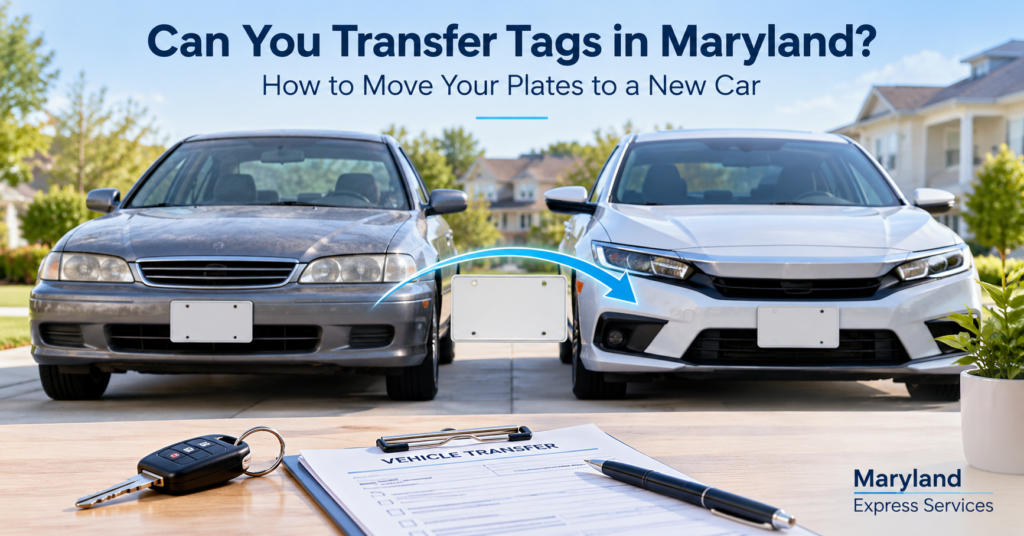

Trading in your old car, or buying your next one before the year ends? You may not need new license plates. Maryland lets many owners move their current tags to the vehicle that replaces the old one, and the MVA transfer fee is $15. This guide covers who qualifies, what it costs, what to bring and what to do with plates you don’t keep. We’re Maryland Express Services, an MVA authorized tag and title agent in Reisterstown, and we help drivers from Owings Mills, Baltimore County and across Maryland with plate transfers.
Can you transfer tags in Maryland?
Yes, if you meet three conditions. A tag transfer is allowed under Transportation Article § 13-502.1, and the MVA’s rules are in COMAR 11.15.11.02. According to the MVA License Plates page, you may be able to transfer plates when all three of these apply.
1. The new vehicle is titled in the same name
Plates are issued in the owner’s name, so the new vehicle has to be titled in the same name as the vehicle that had the plates. If the names don’t match, for example because you’re adding a co-owner or buying the new car in a company name, ask us before you buy. A name change can mean new plates instead of a transfer.
2. The vehicle class and plate type fit
The MVA describes plate transfers for three classes: Class A (passenger cars), Class M (multipurpose vehicles) and Class E (trucks), and the plate type has to stay the same. COMAR 11.15.11.02 allows transfers between those three classes, so moving your tags from a car to an SUV or a pickup can still work, depending on how each vehicle is classed.
3. You no longer have the old vehicle
The vehicle the plates came from must have been sold, traded, junked or otherwise disposed of. You can’t keep the old car on the road and move its plates to the new one.
When you can’t transfer your plates
- The buyer of your old car wants your tags. The MVA’s Selling a Vehicle page says plates stay with the seller, not the vehicle. Take them off before the buyer drives away, and don’t let the buyer use them.
- You owe money on a registration payment schedule. The MVA’s payment schedule terms state that tags can’t be transferred to another vehicle while a registration debt is owed to the MVA (MVA fees page).
- The new vehicle isn’t Class A, E or M. The MVA’s example is moving passenger plates to a taxicab, which means new plates and the full registration fee for that class.
- The names on the titles are different. See the condition above, and talk with us first.
If you can’t transfer, the new vehicle gets new plates when you title and register it, and plates you no longer need go back to the MVA. See what to do with plates you don’t keep below.
Plates and family gifts
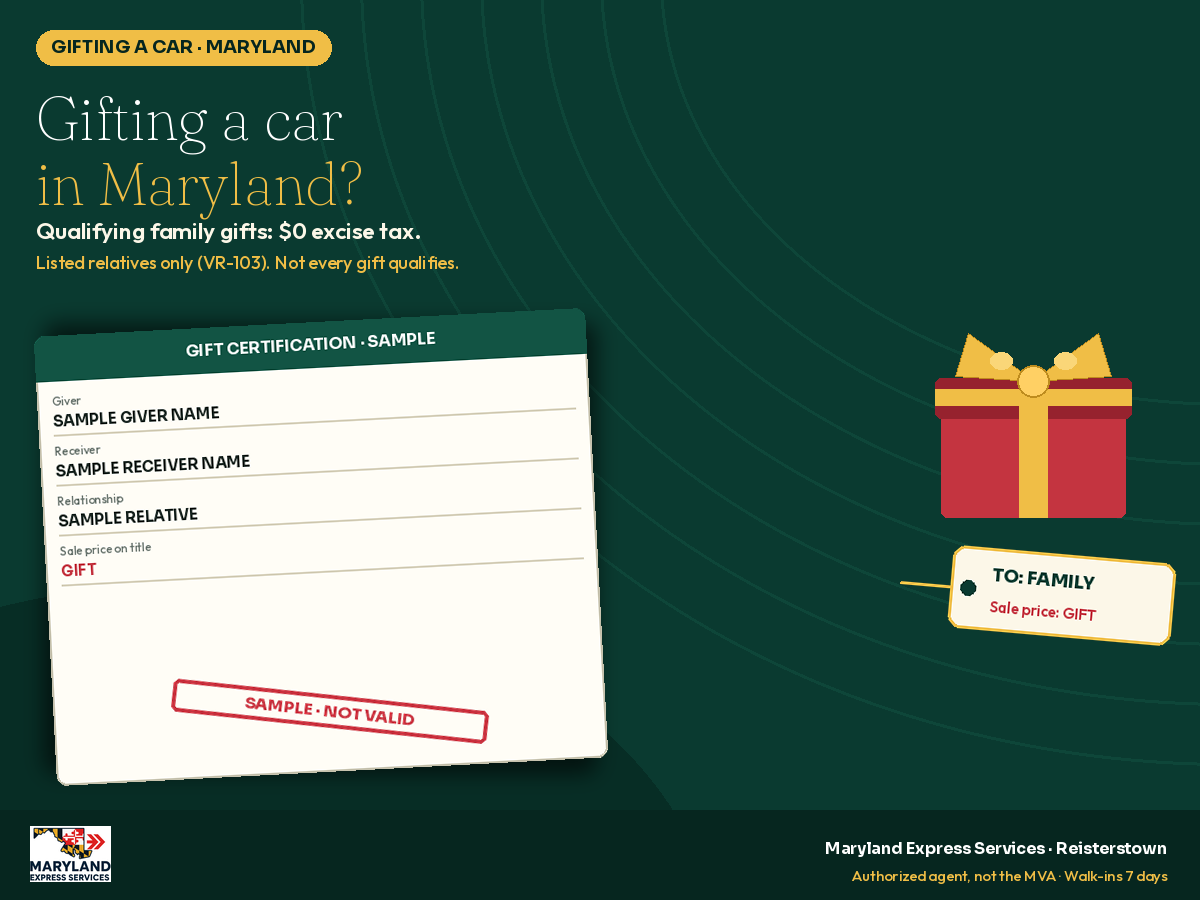
Plates can move between family members only in one case: between a spouse, parent or child. The MVA’s License Plates page says plates may be transferred between immediate family members (spouse, parent, or child) when the vehicle is given as a gift. For other relatives, such as siblings, grandparents or in-laws, new plates must be purchased. To count as a gift, the MVA requires that no money or other valuable consideration is involved, and its gift form (VR-103) may be used only for vehicles titled in Maryland. Transportation Article § 13-503.1 spells out the spouse and parent-child transfers where the new owner can keep using the same plates on that vehicle.
The title side of a gift has its own rules. The gift has to be between relatives listed on Form VR-103, and the MVA says to write “GIFT” in the sale price field instead of leaving it blank (MVA: Giving a Vehicle as a Gift). Our guide on how to gift a car in Maryland walks through it.
How much does it cost to transfer tags in Maryland?
The MVA’s registration/tag transfer fee is $15. That amount appears on the MVA fees page, on Form VR-008 and in COMAR 11.11.05.04. Two other rules can change your total:
- A higher registration fee on the new vehicle. If the new vehicle’s registration fee is higher than the old one’s, you pay the $15 plus the difference. If it’s lower, the MVA doesn’t have to refund the difference (§ 13-502.1).
- Less than 12 months left on your registration. VR-008 says the registration will be renewed for an additional year when you transfer plates with less than 12 months left. The MVA Title and Registration Manual says an additional year’s registration fee and surcharge are collected in that case.
The exact amount for your vehicles is calculated when the transaction is processed. The MVA’s April 7, 2025 bulletin on transferring plates also says moving Class A, E or M plates to any other class (its example is a taxicab) means new plates and that class’s full registration fee.
The plate transfer only covers registration. The new vehicle is still titled the normal way, so the $200 title fee and the 6.5% titling (excise) tax apply unless an exemption fits your case. If you trade in a vehicle at a dealer, the 6.5% excise tax is figured on the price minus the dealer’s trade-in allowance, so you pay tax only on the difference (Transportation Article § 13-809; COMAR 11.15.33.05). The credit applies to a vehicle traded to a dealer, and only one trade-in can be applied to a purchase. It doesn’t apply to a private sale, where there is no dealer trade-in. A tag and title agent also charges its own service fee. For the full list of state fees, see Maryland tag and title costs and how Maryland excise tax is calculated.
Keeping your plates? We can help.
Visit Maryland Express Services in Reisterstown, open 7 days a week. Call, text or WhatsApp (443) 826-7843.
What you need to transfer tags
You ask for the plate transfer at the same time you title and register the new vehicle. The MVA Register a Vehicle page and Form VR-008 point to this list:
- Your current registration card from the plates you’re keeping. VR-008 asks you to attach a copy.
- Your tag number, sticker number and expiration date. These go on the application.
- The title or title application for the new vehicle. If the vehicle is already titled in your name and you only need the plate transfer, the MVA form is the Application for New Plates/Stickers & Transfer of Plates (VR-008).
- Proof of Maryland insurance on the new vehicle. The current VR-008 (08-26) asks for the insurance company, policy or binder number, and the insurer’s NAIC number.
- A Maryland Safety Inspection Certificate, if required. The MVA says most vehicles must pass a safety inspection before they can be titled and registered. See when a Maryland safety inspection is required.
- Each owner’s driver’s license number and date of birth. VR-008 asks for them, and every owner signs.
- Payment for the transfer fee, any registration fee difference, and the title fees and taxes.
Buying from a private seller? You’ll also want the signed title and, in many cases, a bill of sale. Keep that part simple and see our guide on whether a Maryland bill of sale needs a notary. Our Maryland tag and title checklist covers the rest.
How to transfer your tags to a new car, step by step
- Check that you qualify. Same name on both titles, a vehicle class that fits, and the old vehicle sold, traded, junked or disposed of.
- Take your plates off the old vehicle before the buyer or dealer takes it. Plates stay with you, not the car.
- Insure the new vehicle with a Maryland-licensed insurer.
- Get a safety inspection if the new vehicle needs one.
- Apply for the transfer when you title and register the new vehicle. The MVA lists three ways: an MVA full-service branch, by mail (the MVA lists its mailing address on its title application by mail page), or an MVA-licensed tag and title service like us.
- Get your new registration card and sticker, then put your plates on the new vehicle and keep the registration card in it.
Don’t drive the new vehicle on your old plates before the transfer is done. Under Transportation Article § 13-502, the new owner of a registered vehicle has to get a new registration before driving it on the road.
Buying from a dealer
Dealers can process tag transfers too. In its August 17, 2026 bulletin on ERT tag transfers, the MVA said the electronic registration system now handles transfers between vehicles of different weights, with the fee difference calculated, so these no longer have to be sent to the MVA. The MVA recommends doing the tag transfer at the time of sale so you leave with a new registration card and sticker. If the dealer transfers your tags instead of issuing a temporary tag, keep the yellow or white copy of the 60-day Temporary Registration Permit (CS-124) in the vehicle until your title arrives.
Buying from a private seller
Bring the signed title, your registration card and your insurance information to us, and we can review your paperwork before we start. If you’re buying and want to drive home legally, see our guide on getting plates the same day after a private sale.
What to do with plates you don’t keep
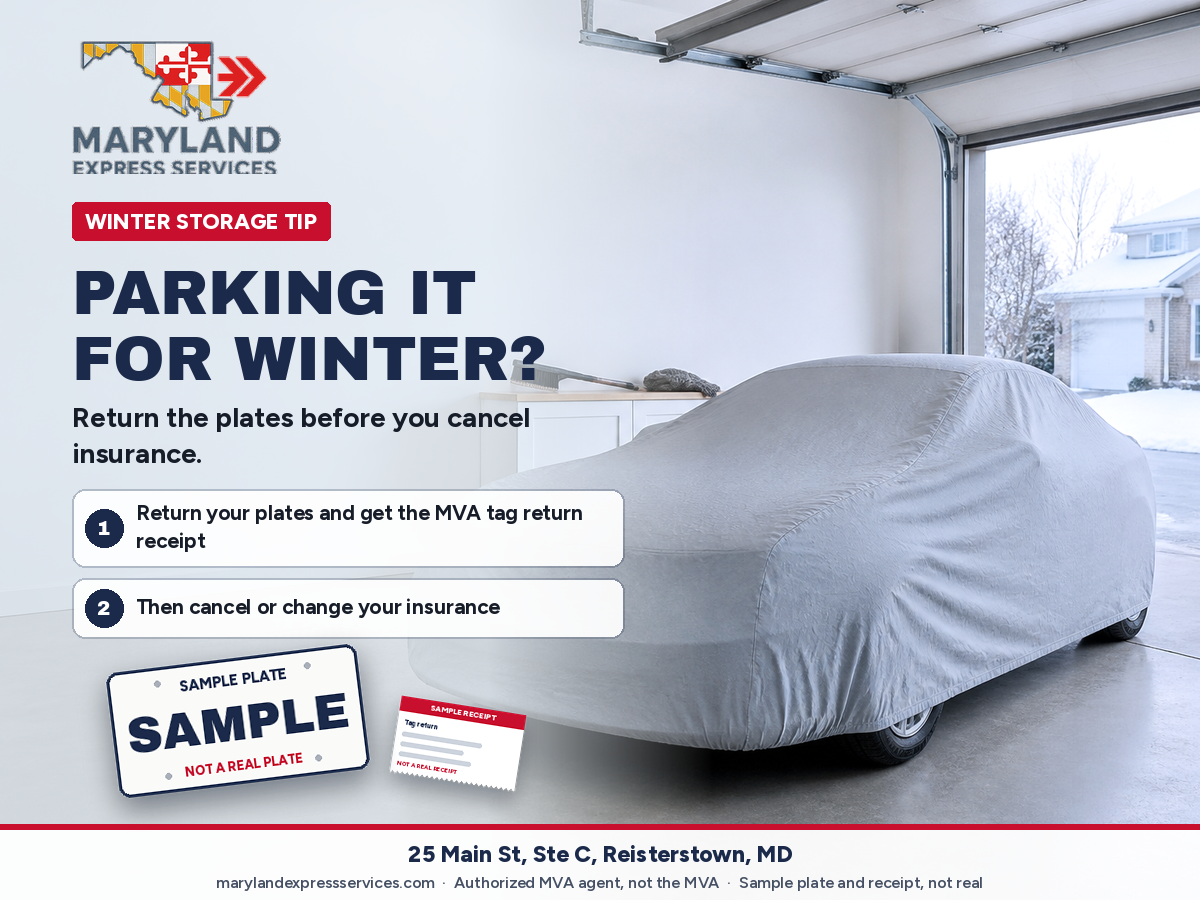
If you aren’t transferring your old plates, return them. The MVA’s Returning Maryland License Plates page says to return plates when you sell, trade or junk a vehicle, cancel its insurance, or move out of Maryland, and to keep your insurance active until you have your tag return receipt. You have three options:
- The counter at any MVA branch. Drop off the plates and get a printed receipt.
- An MVA 24-hour drop box. Put the plates in an envelope with Form VR-027 and the registration card wrapped around them. In our experience, a drop box return takes 3 to 5 business days to show in the MVA system.
- A tag and title agent like Maryland Express Services. We give you a receipt on the spot, and the return is recorded in the MVA system right away.
You may be eligible for a registration refund (Form VR-021) if your plates have more than 12 months left. Read more in our guide to returning license plates in Maryland and our checklist for what to do after selling a car in Maryland.
Transfer your tags at Maryland Express Services in Reisterstown
We’re an MVA authorized tag and title agent, and tag transfers are part of our everyday tag and title services. We process most tag transfers in our office through the MVA’s electronic registration system (ERT), including transfers of existing personalized or organizational tags. The MVA Title and Registration Manual (“What transactions CANNOT be processed by ERT Title Services?”) says title services can’t brand titles (other than CAL LEV and odometer brands) or issue new personalized or organizational tags in ERT, and it lists “MD salvage/ branded titles” among transactions handled outside ERT. For those, such as a salvage or rebuilt title or a new personalized or organizational tag, we submit the work through the MVA’s business portal. The Manual also says these are “still eligible for over-the-counter processing with an appointment” at the MVA, including “MD salvage/ branded titles” and “registration transactions not able to be processed via kiosk or ERT.” We can review your paperwork before we start and tell you up front which route your case takes. If a document needs a notary, we notarize documents at our Reisterstown office.
Visit us at 25 Main Street, Suite C, Reisterstown, MD 21136. We’re open 7 days a week (Monday to Friday 9 AM to 9 PM, Saturday 9:30 AM to 8 PM, Sunday 10 AM to 7 PM), and walk-ins are welcome. Call, text or WhatsApp (443) 826-7843, or contact us online. Not sure which agent to use? Read how to choose a tag and title agent in Maryland.
Keeping your plates? We can help.
Visit Maryland Express Services in Reisterstown, open 7 days a week. Call, text or WhatsApp (443) 826-7843.
Frequently asked questions
Can I transfer my tags to another car in Maryland?
Yes, in most cases. The new vehicle must be titled in the same name as the vehicle the plates came from (or, for a gift, go to a spouse, parent or child), the vehicle class and plate type must fit, and the old vehicle must have been sold, traded, junked or disposed of. You request the transfer when you title and register the new vehicle.
How much does it cost to transfer tags in Maryland?
The MVA registration/tag transfer fee is $15. If the new vehicle has a higher registration fee, you also pay the difference. If fewer than 12 months are left on your registration, it is renewed for an additional year, and that year’s registration fee is collected. Title fees and titling tax for the new vehicle are separate, and an agent adds its own service fee.
What do I need to transfer my license plates?
Bring your current registration card, your tag and sticker numbers, the title or title application for the new vehicle, proof of Maryland insurance, a safety inspection certificate if one is required, each owner’s license number and date of birth, and payment. If the new vehicle is already titled in your name, use Form VR-008.
Can I move my tags from a car to an SUV or pickup truck?
Often, yes. The MVA allows plate transfers between Class A passenger cars, Class M multipurpose vehicles and Class E trucks, as long as the owner’s name hasn’t changed and the plate type stays the same. If the new vehicle’s registration fee is higher, you pay the difference plus the $15 transfer fee.
Do I get money back if my new car has a lower registration fee?
No. Under Transportation Article § 13-502.1, the MVA doesn’t have to refund the difference when the new vehicle’s registration fee is lower than the old one’s.
Can the buyer of my car keep my plates?
No. The MVA says license plates stay with the seller, not the vehicle. Remove them before the buyer takes the car. Then transfer them to your next vehicle or return them.
Can a car dealer transfer my tags?
Yes. The MVA’s electronic registration system lets dealers process tag transfers, including between vehicles of different weights, and the MVA recommends doing it at the time of sale. Keep the CS-124 permit copy in the vehicle until your title arrives.
Can I transfer tags if I’m on a registration payment schedule?
Not while you owe the MVA. Its payment schedule terms say tags can’t be transferred to another vehicle if a registration debt is owed. Pay the balance first.
Can I transfer my plates to a car in a family member’s name?
Only between a spouse, parent or child. The MVA says plates may be transferred between immediate family members (spouse, parent, or child) when the vehicle is given as a gift. For other relatives, such as siblings, grandparents or in-laws, new plates must be purchased. To count as a gift, no money or other valuable consideration can be involved in the transfer, and the MVA gift form (VR-103) may be used only for vehicles titled in Maryland. Generally, any transfer between spouses or between a parent and child is exempt from the Maryland Safety Inspection. See our guide on how to gift a car in Maryland.
Sources
- MVA: License Plates (Transferring license plates)
- MVA: Fees and Payment Options
- MVA: Application for New Plates/Stickers & Transfer of Plates, VR-008 (08-26)
- MVA: Register a Vehicle in Maryland
- MVA: Returning Maryland License Plates
- MVA: Selling a Vehicle
- MVA: Giving a Vehicle as a Gift
- MVA: Gift Certification, VR-103 (04-26)
- MVA: Vehicle Emissions & Safety Inspections
- MVA bulletin: ERT Tag Transfers (August 17, 2026)
- MVA bulletin: Transferring Plates (April 7, 2025)
- MVA Title and Registration Manual
- MVA: Titling a Vehicle Bought from a Private Party (mailing address)
- Maryland Transportation Article § 13-809 (excise tax)
- COMAR 11.15.33.05 (trade-in allowance)
- Maryland Transportation Article § 13-502.1
- Maryland Transportation Article § 13-502
- Maryland Transportation Article § 13-503.1
- COMAR 11.15.11.02 (transfer of registration plates)
- COMAR 11.11.05.04 (vehicle registration fees)
Disclaimer: Maryland Express Services is an authorized agent of the Maryland Motor Vehicle Administration (MVA). We are not the MVA and are not a government office. This article is general information, not legal advice. MVA fees and rules can change, so check the linked MVA pages for the latest details. Information verified October 21, 2026.