
Short answer: sign the title over, sign a bill of sale, take your plates off, return them, and keep your insurance until you have the plate return receipt. Then file four papers somewhere safe. Maryland has no separate release-of-liability form, so those papers are what prove the car stopped being yours.
Selling a car privately in Maryland feels finished once the buyer drives away, but the steps you take that day protect you for months. We help sellers from Reisterstown, Owings Mills, and across Baltimore County with this every week. Here’s the seller’s checklist, in order.
Need help with your tag or title?
Visit Maryland Express Services in Reisterstown, open 7 days a week. Call, text or WhatsApp (443) 826-7843.
Selling a car privately in Maryland: the seller's steps
- Make sure your title is valid and in your name. Any loan must be released before the sale. See paying off a lien before a title transfer.
- Fill out the back of the title completely: the buyer’s name and address, the sale price, the odometer reading, the date, and every owner’s signature (unless the title says “OR”). Don’t leave blanks.
- Sign a bill of sale with the buyer, ideally MVA form VR-181, and keep a copy.
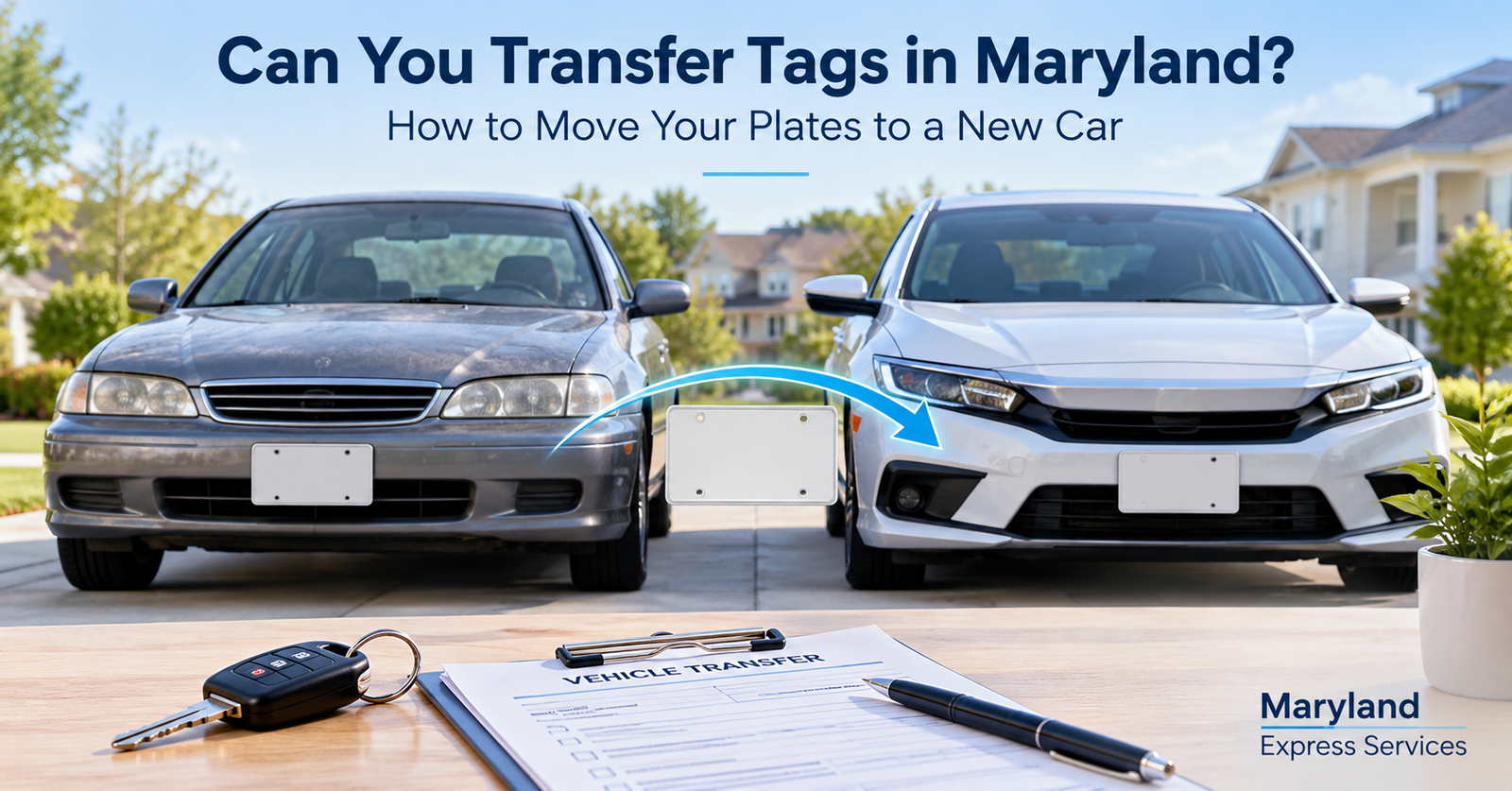
- Take your plates off before the buyer drives away.
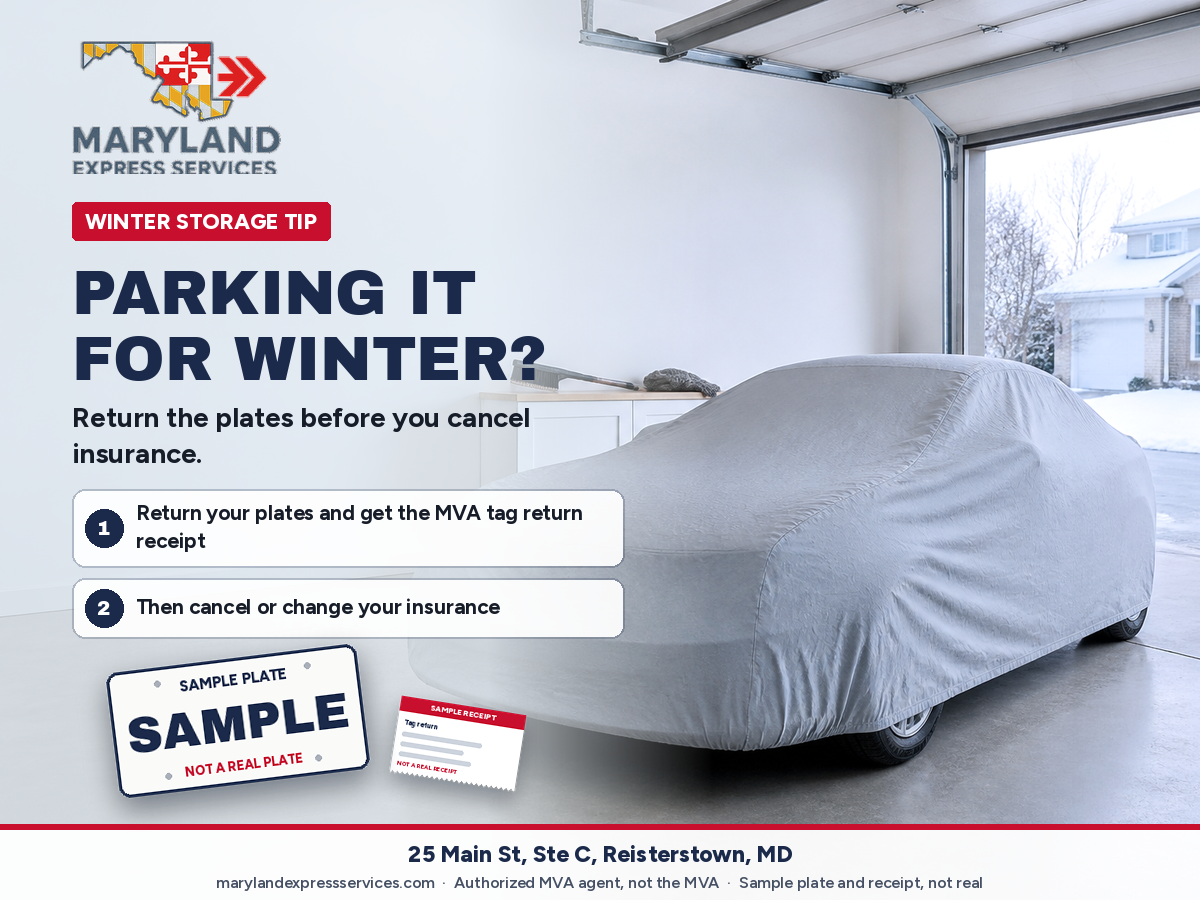
- Return the plates and keep the receipt.
- Keep your insurance until you have that receipt.
- File your 4 papers (listed below).
Before you list the car, it also helps to check it for MVA flags so nothing holds up the buyer’s title.
Selling a car in Maryland: the bill of sale (no notary needed)
As of October 1, 2026, Maryland no longer requires a notarized bill of sale for private sales of vehicles under 7 years old (SB 125 / HB 251; see the MVA bulletin dated Sept. 15, 2026). The MVA’s own form, VR-181 (rev. 10-26), no longer has a notary section. Everyone listed as a seller or buyer just signs it.
It’s still worth doing. According to the MVA’s Selling a Vehicle page, “A bill of sale helps protect both the buyer and seller.” For you as the seller, it’s dated, signed proof of exactly when ownership changed hands. Along with the vehicle details, price, date, names, and signatures, we suggest adding:
- The odometer reading at the sale.
- The time of the sale, not just the date. It isn’t required, but it helps if a camera ticket lands on the same day.
- An “as is” line, if that’s your deal. Under Maryland’s commercial law (§2-316), wording like “as is” generally excludes implied warranties. That’s general information, not legal advice.
What about the buyer? The bill of sale also helps the buyer back up the price for excise tax and get the title accepted. We cover that side in our buyer guide to Maryland’s no-notary rule and our Maryland bill of sale guide.
Selling a car in Maryland: what happens to the license plates?
In Maryland, the plates belong to the seller, not the car. The MVA says to remove them before the buyer takes possession and not to let the buyer use them. You can keep them only if you’re moving them to another vehicle you own.
Can the buyer drive on my plates for a few days? The law technically allows it. Under Transportation Article §13-501, a seller may give the buyer written permission to use the plates, and the buyer can then drive with them for no more than 10 days before returning them. However, the MVA’s current guidance for sellers is not to let the buyer use your plates, and anything that happens with those plates during those days points back to you. The safest choice is to keep your plates.
How to return plates after selling a car in Maryland
The MVA’s Returning Your License Plates page lists the options:
- At an MVA office: drop them in a 24-hour tag return box with form VR-027, or go to the information counter for a printed receipt on the spot.
- By mail: certified mail with return receipt requested is recommended.
- Your receipt: you can download it through myMVA. Allow 72 business hours after a drop-box return.
Keep your insurance until you have the receipt. The MVA says to keep coverage active until you get your tag return receipt. Canceling first can lead to insurance penalties. See what an insurance lapse costs in Maryland. If a plate was lost or stolen, see our lost license plate guide.
What to do after selling a car in Maryland: keep these 4 papers
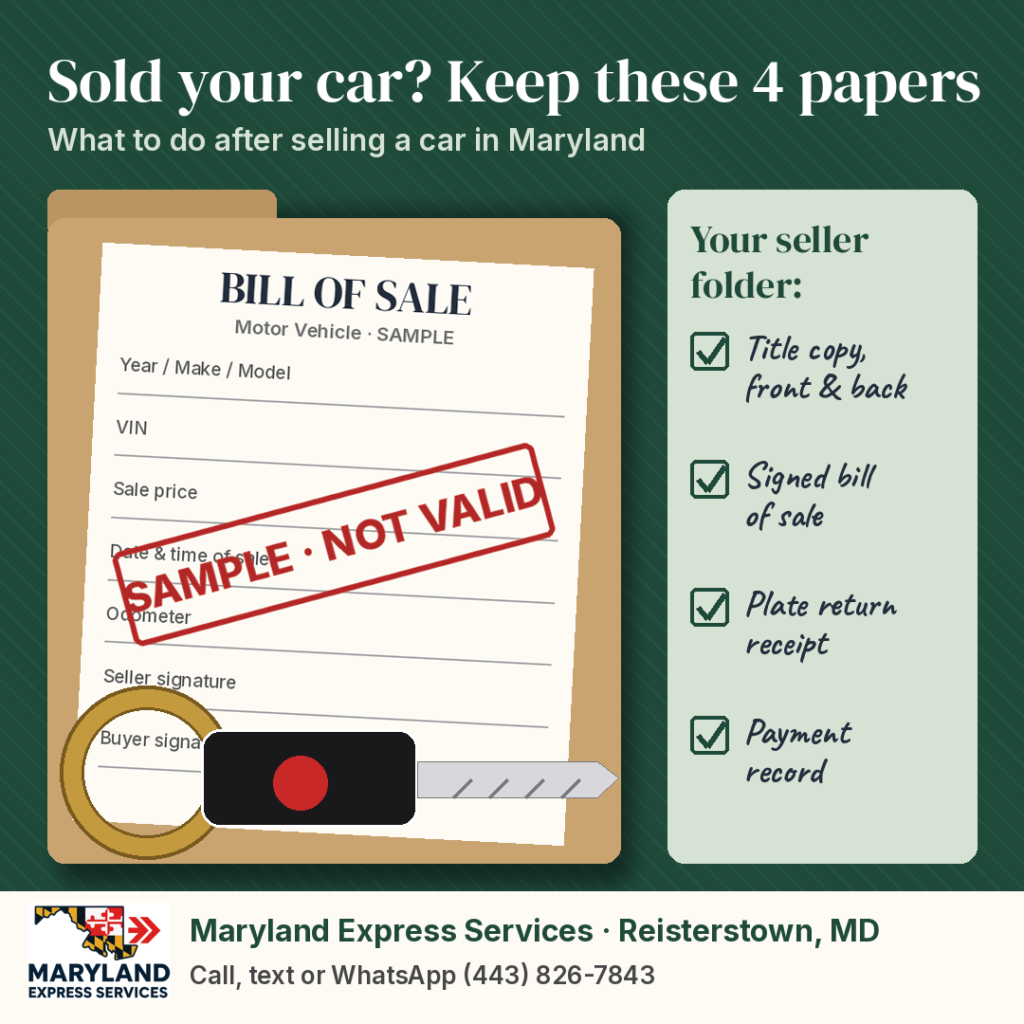
The MVA tells sellers to keep their plate return receipt and copies of the completed title and bill of sale, noting that “These records protect you if questions come up later” (MVA). We suggest a simple folder with four items:
- A copy of the signed title, front and back, taken before you hand it over. A phone photo works.
- Your copy of the signed bill of sale.
- Your plate return receipt.
- A record of payment, such as a bank transfer confirmation or a copy of the check.
Keep the folder for at least as long as tickets, tolls, or questions could still come up. Some sellers keep it for years.
Is there a Maryland release of liability form for sellers?
No. Unlike some states, Maryland’s MVA doesn’t list a separate release-of-liability or notice-of-transfer filing for sellers. Its seller steps are to complete the title, provide a bill of sale, remove and return the plates, and keep your records. That’s exactly why the papers above matter so much.
Sold your car and still getting tickets?
It happens more than you’d think. A buyer never retitles the car, keeps driving on the old plates, or someone misuses the old paperwork. In one recent Maryland news report, a man who had given away an SUV and turned in his plates kept getting camera and toll notices for months after someone used forged signatures to register the vehicle in his name again.
Paperwork can’t always stop fraud, but it’s what lets you prove your side. If notices keep arriving:
- Don’t ignore them. Respond by the deadline on each notice.
- Send proof that you no longer owned the car: your bill of sale (with date and time), the copy of the signed title, and your plate return receipt.
- Contact the MVA at 410-768-7000. The MVA has told reporters that people who give up their plates should keep a record of when and where they did so, and it can help sort out a disputed record.
- If you suspect forgery or fraud, report it to your local police and keep the report number.
Selling a car in Maryland to an out-of-state buyer or a family member
- Out-of-state buyer: your plates still stay with you. The buyer can get a 14-day in-transit tag from the MVA or a licensed tag and title agent. See our in-transit tag guide.
- Family member: a gift between eligible relatives follows different rules. See gifted vehicles in Maryland.
Selling several cars a year? Know the dealer rule
Under Transportation Article §15-101, anyone who offers to sell three or more vehicles in a 12-month period is presumed to have bought them for resale, which is dealer activity that requires a license. The MVA warns buyers about “curbstoners,” unlicensed sellers who pose as private sellers (MVA Buying a Vehicle). If you’re clearing out several family cars, keep records showing they were personal vehicles. This is general information, not legal advice.
How Maryland Express Services can help
We’re an MVA-licensed tag and title agent in Reisterstown, open 7 days a week with evening hours, and walk-ins are welcome. We can look over the title and bill of sale before you sign, help the buyer finish the title transfer, and answer questions about plates. Bring our tag and title checklist, or see all our tag and title services.
Related guides
- No notarized bill of sale required (buyer guide)
- Maryland bill of sale guide
- Check a car for MVA flags before a private sale
- 14-day in-transit tag for out-of-state buyers
- Lost license plate in Maryland
- Insurance lapse in Maryland
- Tag and title checklist
- Tag and title services
Official sources
- MVA: Selling a Vehicle
- MVA: Returning Your License Plates
- MVA Bulletin: SB 125 / HB 251 repeal of notarized bill of sale requirement (Sept. 15, 2026)
- MVA Form VR-181: Bill of Sale
- Transportation Article §13-501 (plates after transfer)
- Transportation Article §15-101 (dealer definition)
- Commercial Law §2-316 (warranty exclusions)
- MVA: Buying a Vehicle (curbstoner warning)
Frequently asked questions
What do I need to do after selling a car in Maryland?
Remove your plates, return them to the MVA, and keep the receipt. Keep your insurance until you have that receipt. Also keep copies of the signed title (front and back), the bill of sale, and your payment record.
Do you need a bill of sale to sell a car in Maryland?
It’s strongly recommended. The MVA says a bill of sale helps protect both the buyer and seller. Since October 1, 2026, it doesn’t need to be notarized; MVA form VR-181 just needs everyone’s signatures. Buyers can see our no-notary guide for their side.
Do I keep my license plates when I sell my car in Maryland?
Yes. Plates stay with the seller. Return them to the MVA, or keep them only if you’re transferring them to another vehicle you own.
Can the buyer drive on my plates in Maryland?
The law allows it for up to 10 days with your written permission (Transportation Article §13-501), but the MVA advises sellers not to let buyers use their plates. Keeping your plates is the safer choice.
When can I cancel my insurance after selling my car?
After you get your tag return receipt. The MVA says to keep insurance active until your plates are confirmed returned. Online receipts can take up to 72 business hours after a drop-box return.
Is there a release of liability form in Maryland?
No. The MVA doesn’t list a separate release-of-liability filing for sellers. Your signed title copy, bill of sale, and plate return receipt are your proof of the sale.
I sold my car and I'm still getting tickets. What do I do?
Respond to each notice with proof of the sale: the dated bill of sale, the signed title copy, and the plate return receipt. Contact the MVA at 410-768-7000, and report suspected fraud to the police.
Selling a car near Reisterstown?
Selling your car? Bring the title and bill of sale by our Reisterstown office and we’ll help make sure the paperwork is right before you hand over the keys.
Maryland Express Services LLC
25 Main St Ste C, Reisterstown, MD 21136
Call, text, or WhatsApp (443) 826-7843 · Fax (410) 465-1054
marylandexpressservices.com · Contact Us
Mon–Fri 9 AM–9 PM · Sat 9:30 AM–8 PM · Sun 10 AM–7 PM
Maryland Express Services LLC is an MVA-licensed title service agent, not a government office, not the Maryland Motor Vehicle Administration, and not affiliated with the MVA. This post is general information based on mva.maryland.gov, MVA business bulletins, and Maryland law as of October 2026, not legal advice. Rules can change, so check the MVA website for the latest.