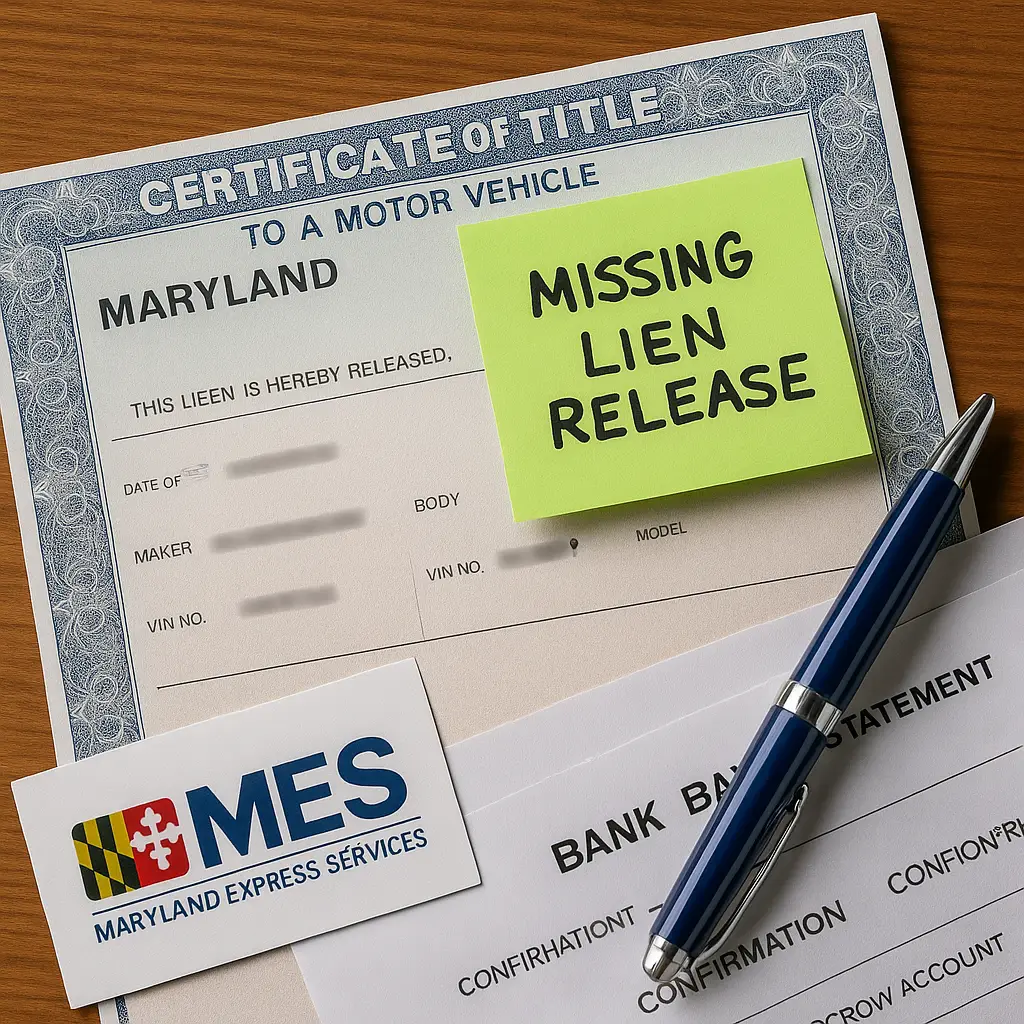

Ever paid off a car loan but can’t get the lien release letter? Maybe the bank merged, the dealership closed, or the finance company simply vanished. It happens more often than you’d think—and without that official release, the MVA or DMV won’t let you transfer or retitle the vehicle.
At Maryland Express Services (MES) in Ellicott City, we’ve helped dozens of customers in this exact situation—from a Texas title with a defunct lienholder to local Maryland cases involving old credit unions and dealer financing. Here’s what you need to know and how to fix it legally.
What a Lien Release Letter Actually Does
A lien is a lender’s legal claim on a vehicle until the loan is paid in full. The lien release letter proves that you now own the vehicle free and clear. The release must include:
- VIN (Vehicle Identification Number)
- Account or loan number
- Date of payoff
- Authorized signature or stamp from the lienholder
Without it, the state assumes the lender still has a financial claim—and the title remains encumbered.
Why Missing Lien Releases Happen
- The lender merged or went out of business.
- The loan was refinanced or sold to another company.
- The dealer financed the loan in-house and later closed.
- Customer misplaced or never received the lien release letter after payoff.
Each situation needs a different approach depending on the type of lienholder and the state where the title was issued.
Understanding Lienholders — and How Each Type Handles Release Letters
1️⃣ National & Major Banks
Big banks like Wells Fargo, Chase, Capital One, or Bank of America use electronic lien systems (ELT). Once the loan is paid off, they either send a paper title with “lien released” or electronically notify the state DMV.
How to verify:
- Contact the bank’s auto loan title department (not general support).
- Request a lien release confirmation or ELT verification with VIN and payoff date.
- If the bank merged, contact the successor institution for reissue.
🔗 FDIC BankFind Suite — trace merged or closed banks.
2️⃣ Local or Regional Banks
Community banks usually mail physical lien release letters or stamp the title. If the bank was absorbed, you must find who took over its accounts.
Tip: ask the current branch for their “loan servicing successor.” They can confirm if your loan records were migrated.
3️⃣ Credit Unions (Non-Profit Lenders)
Credit unions handle lien releases manually and may need a signed request before issuing the letter—even for closed loans. Many are not part of ELT systems.
🔗 NCUA Credit Union Locator — verify or locate merged credit unions.
Gotcha: Merged credit unions can take weeks to verify old records. If your loan was paid through an older branch, be patient but persistent.
4️⃣ Dealer Financing (In-House Loans or “Buy-Here-Pay-Here”)
When the dealership itself is the lienholder, you need a notarized lien release letter on dealer letterhead. If the dealer is out of business, you must contact the state’s Dealer Licensing Division to find out who controls their records.
In Maryland, you can check with the MVA Dealer Services Section for guidance.
5️⃣ Private Finance Companies
Private lenders or title-loan companies may issue a notarized lien release directly. If they’re dissolved, search your state’s Secretary of State business entity database to confirm closure.
Once confirmed, contact the DMV in the issuing state to file for a bonded title or affidavit of lien satisfaction.
When the Lienholder No Longer Exists
Here’s how to clear your title when no one can issue a lien release:
- Gather proof of payoff: canceled checks, bank statements, or payment receipts.
- Contact the DMV in the state that issued the title (e.g., Texas, Virginia, Maryland).
- Request instructions for a Bonded Title or Affidavit of Lien Release.
- Submit documentation and a surety bond if required.
- Receive a new, clean title showing no lien.
🔗 Texas DMV – Lien Release Processhttps://www.txdmv.gov/motorists/buying-or-selling-a-vehicle/add-remove-lien
🔗 Virginia DMV – Title & Lien Informationhttps://www.dmv.virginia.gov/vehicles/title/liens/satisfaction
🔗 Maryland MVA – Lien Release Informationhttps://mva.maryland.gov/about-mva/Pages/info/27300/27300-18T.aspx
Common Scenarios We See at MES
- Defunct dealership: Buyer has old dealer-financed title and no release—requires affidavit + proof of payment.
- Credit union merger: New CU has no digital record of the old loan—needs a verification request form.
- Bank merger (e.g., Wachovia → Wells Fargo): Must obtain release from successor’s lien department.
- Private lienholder deceased: Estate may need to issue lien release with court documentation.
How MES Can Help
At MES Tag & Title Services, we can:
- Review your title and verify whether the lienholder still exists.
- Contact the correct state agency or successor lender on your behalf.
- Assist with bonded title or lien satisfaction affidavit paperwork.
- Handle title corrections or reissues once the lien is cleared.
Bring your documents to our Ellicott City office or contact MES for guidance before submitting to MVA.
References & Resources
- FDIC BankFind Suite – Trace old banks and lenders
- NCUA Credit Union Research Tool
- Maryland MVA – Lien Information
- Texas DMV – Lien Release
- Virginia DMV – Titles & Liens