
A common fall plan goes like this: “I’m putting the convertible away until spring, so I’ll just cancel the insurance.” In Maryland, that one step in the wrong order can cost you. As long as a vehicle is registered, the state expects it to be insured, whether it’s parked under a cover in the garage or out on the road every day. The timing matters this year: on October 21, 2026, the Maryland Insurance Administration sent insurers a bulletin about exactly this situation, including drivers who drop coverage for seasonal use. This guide explains the rule, what a lapse can cost, and how to put a car or motorcycle away for the winter without a surprise notice from the MVA. We’re Maryland Express Services, an MVA authorized tag and title agent in Reisterstown, serving drivers from Owings Mills, Baltimore County and across Maryland.
The short answer
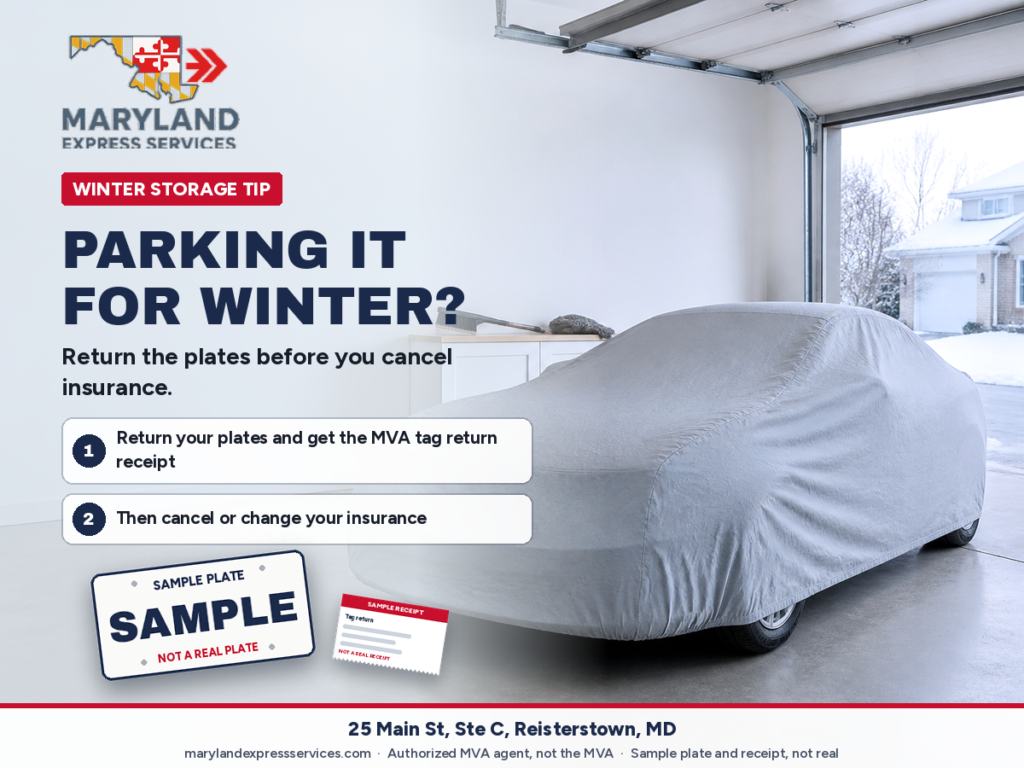
If you want to drop your insurance while a vehicle sits for the winter, return the plates first. Wait until you have the tag return receipt in hand, and only then cancel or reduce the policy. If you’d rather keep the plates, keep the full Maryland-required coverage in place all winter. There’s no in-between where the plates stay active and the insurance goes away.
Why Maryland requires insurance on a car you aren’t driving
In Maryland, the insurance requirement follows the plates, not the odometer. Under Transportation Article § 17-104, the owner of a registered vehicle must keep the required security in place for the whole registration period. The MVA’s auto insurance requirements page spells out the minimum liability coverage ($30,000 per person and $60,000 per accident for bodily injury, and $15,000 for property damage) and adds that “these minimums are required even if the vehicle is not being driven.” Its insurance penalties page says the same thing a different way: insurance is required at all times while a vehicle is registered.
Insurers report coverage to the MVA electronically. When a policy ends, the insurer reports that too, so the MVA usually learns about a canceled policy without you telling anyone.
What an insurance lapse can cost
Under Transportation Article § 17-106, when coverage on a registered vehicle lapses, the registration is suspended automatically. The same section lets the MVA assess a penalty of $200 for a lapse of 1 to 30 days, then $7 more for each day starting on day 31, up to $3,500 per violation in a 12-month period. The MVA’s penalties page warns that unpaid penalties can lead to registration suspension and vehicle flags, and that a case sent to the state’s Central Collection Unit (CCU) picks up an extra 17%. If you’re already dealing with one, read how to fix an insurance lapse in Maryland and how to pay MVA flags.
The 10-day window doesn’t cover winter storage
Section 17-106 does spare some owners who return their plates within 10 days of the lapse, but only in specific situations: the title has been transferred to a new owner, the owner moved out of state and mailed the plates back, a salvage certificate was issued, or a licensed dealer took the vehicle and has to return the plates. Parking your own car for the season isn’t on that list. If you’re storing a vehicle, plan on returning the plates before the policy ends, not after.
Putting a car away for the winter? Bring us the plates.
Maryland Express Services, 25 Main St, Ste C, Reisterstown, MD 21136. Open 7 days a week. Call, text, or WhatsApp (443) 826-7843. Fax (410) 465-1054.
Two ways to handle a car you’re parking for the winter
Option 1: Keep it registered and keep the insurance
This is the simplest route if the car will only sit for a few months. Nothing changes with the MVA, the plates stay on the car, and you can drive it on the first warm weekend. Before you change your policy, ask your insurance agent whether the coverage you’re switching to still meets Maryland’s minimum liability requirements. If the new policy drops below the state minimums while the plates are still active, you’re exposed to the same lapse penalty as if you had canceled outright.
Keeping the registration also means keeping up with it. If a Vehicle Emissions Inspection Program (VEIP) notice arrives while the car is parked, the test is still due. The MVA’s emissions inspection page lists extensions and exemptions for some situations, such as a vehicle that’s out of state. If the registration expires during the winter, renew it before you drive; our Maryland registration renewal guide covers the steps.
Option 2: Return the plates first, then change the insurance
If the car will sit for a long stretch, or you’d rather not insure it at all, return the plates. The MVA’s Returning Your License Plates page lists “no longer use your vehicle” and “cancel your insurance coverage” among the reasons you must return them, and it says to keep your insurance active until you receive your tag return receipt. The MVA’s tag return form puts it plainly: “Be sure to wait to cancel your insurance until you have downloaded or received the receipt.”
Once the plates are back, the registration is closed. Under Transportation Article § 13-401, a vehicle whose registration has been canceled may not be driven on a Maryland highway, so the car stays parked off the road until you register it again.
What about keeping comprehensive coverage only?
Some owners want to drop liability coverage but keep comprehensive, so the parked car is still covered for things like theft or a falling tree. The Maryland Insurance Administration’s Bulletin 26-25 (October 21, 2026) names seasonal vehicle use as one reason people ask for this. It says insurers may accommodate the request, but once the vehicle lacks the minimum liability coverage, the insurer must first tell you in writing that the plates have to be returned to the MVA, and it must stop reporting the policy to the MVA as active. In other words, comprehensive-only coverage works only after the plates are back. Maryland regulations (COMAR 11.18.04.03) require insurers to warn customers that plates must be returned “on or before the date the insurance policy expires or is canceled.”
Financed or leased? The Maryland Insurance Administration’s vehicle registration FAQ notes that most loans require comprehensive and collision coverage, so ask your lender before you change anything. Insurance decisions are between you, your insurer and your lender; we handle the MVA side.
How to return your plates
Take both plates off the vehicle, front and back, and fill out the MVA’s Tag Return Form (VR-027). Then choose one of these:
- At an MVA branch information counter. You get a printed receipt right away.
- In an MVA 24-hour tag return drop box. The MVA says: “Please allow 72 hours (business days) from the time of the drop before searching for your tag return receipt in our systems.”
- With a licensed tag and title agent. As our office practice in Reisterstown, we process your tag return and give you the official MVA Returned Tag Receipt on the spot, so you can send it to your insurance company the same day.
For the full walk-through, including lost plates and moving out of state, see our guide on how to return tags in Maryland.
Before you turn in the plates: refunds, payment plans and flags
- Refunds are limited. According to the MVA, you may get 50% of the registration fee back if the plates have more than one year left, or 100% for unused plates whose sticker was never put on. There’s no refund if less than a year remains or if the registration is on a payment schedule. The refund needs the Registration Plate Refund Application (VR-021), and the MVA says it arrives from the Comptroller within about 6 weeks.
- Payment plans don’t go away. If you split your registration fee with the MVA’s payment schedule, the MVA fees page says you are still responsible for the second payment after you return the tags.
- Flags follow the vehicle record. Returning plates doesn’t erase an existing flag. If you’re not sure what’s on your record, check your MVA flags in myMVA before you plan the spring.
Getting back on the road in the spring
When the weather turns, put insurance back in place first. Section 17-104 says the MVA may not issue a registration until the owner shows that the required insurance is in effect. Then register the vehicle again and pay the registration fee for the term you choose; the MVA fees page lists current amounts, and our Maryland tag and title fee guide explains how state fees work. The MVA’s Title and Registration Manual lists new tag registrations and tag returns among the transactions licensed title services can process electronically, so you can handle both ends of the winter with a tag and title agent instead of a branch visit.
If you returned your plates for the winter, keep in mind that the MVA says that after it receives returned plates, “your license plate and registration record will be closed.” Its License Plates page explains how plates are issued when you register a vehicle.
Because every record is different, call or text us before you come in. We can review your paperwork and tell you what to bring for your vehicle.
Still driving this winter? Clear the snow
If your car stays on the road, there’s a new rule to know. A Maryland law that took effect October 1, 2026 (HB 474, “Clear Before You Drive”) has the MVA assess one point against a driver’s license when the driver fails to make reasonable efforts to remove snow and ice from the vehicle, and three points if that contributes to a crash, according to the MVA. Brush off the roof, hood and lights before you pull out.
Return plates or re-register in Reisterstown
Maryland Express Services can take your plate return and give you the official MVA Returned Tag Receipt on the spot, register the vehicle again in the spring, renew a registration and help you sort out flags. Visit us at 25 Main Street, Suite C, Reisterstown, MD 21136. We’re open 7 days a week (Monday to Friday 9 AM to 9 PM, Saturday 9:30 AM to 8 PM, Sunday 10 AM to 7 PM), and walk-ins are welcome. Call, text, or WhatsApp (443) 826-7843, fax (410) 465-1054, or contact us online.
Frequently asked questions
Do I need insurance on a car I’m not driving in Maryland?
Yes, if it’s registered. Maryland law requires the owner of a registered vehicle to keep the required insurance for the whole registration period, and the MVA says the minimum coverage is required even if the vehicle is not being driven. To stop insuring it, return the plates first.
Can I cancel my car insurance for the winter in Maryland?
Only after you return the plates. The MVA says to keep your insurance active until you receive your tag return receipt; after you have confirmation that the plates are canceled, you may cancel your insurance. Canceling first can lead to an insurance lapse penalty and a suspended registration.
What is the fine for a lapse in car insurance in Maryland?
Under Transportation Article § 17-106, the MVA may assess $200 for a lapse of 1 to 30 days, then $7 more for each day starting on day 31, up to $3,500 per violation in a 12-month period. Unpaid penalties can lead to registration suspension and flags, and the MVA says cases sent to the Central Collection Unit get an extra 17%.
Can I keep only comprehensive coverage on a car I’m storing for the winter?
Only after the plates are returned. The Maryland Insurance Administration’s Bulletin 26-25 (October 21, 2026) says insurers may let you drop liability coverage for reasons like seasonal use, but once the vehicle lacks Maryland’s minimum liability coverage, the plates must be returned to the MVA or you may face an uninsured motorist penalty. If the car is financed, ask your lender first, because most loans require comprehensive and collision coverage.
Will I get a refund if I turn in my plates for the winter?
Possibly. The MVA lists a 50% refund for plates with more than one year remaining and a 100% refund for unused plates whose sticker was never put on. There’s no refund if less than one year remains or the registration is on a payment schedule. Use form VR-021 and allow about 6 weeks.
How do I get my car back on the road in the spring?
Put insurance in place first, because the MVA may not issue a registration until the required insurance is in effect. Then register the vehicle again and pay the registration fee. If you returned your plates, the MVA closes your license plate and registration record once it receives them. A licensed tag and title agent like Maryland Express Services can process the new registration.
Can a tag and title agent take my plates?
Yes. The MVA’s Title and Registration Manual lists tag returns among the transactions licensed title services can process. As our office practice in Reisterstown, we process the return and give you the official MVA Returned Tag Receipt on the spot.
Return your plates the right way, then relax until spring.
Maryland Express Services, 25 Main St, Ste C, Reisterstown, MD 21136. Open 7 days a week. Call, text, or WhatsApp (443) 826-7843. Fax (410) 465-1054.
Official sources
- MVA: Auto Insurance Requirements
- MVA: Auto Insurance Violation Penalties & Payments
- MVA: Returning Maryland License Plates
- MVA Form VR-027: Tag Return
- MVA Form VR-021: Registration Plate Refund Application
- MVA: Fees & Payment Options
- MVA: Vehicle Emissions Inspections
- MVA Title and Registration Manual
- MVA press release, Sept. 30, 2026: new laws effective October 1
- Maryland Insurance Administration Bulletin 26-25 (Oct. 21, 2026)
- Maryland Insurance Administration: Vehicle Registration FAQs
- COMAR 11.18.04.03 (insurer reporting and plate-return notice)
- Maryland Transportation Article § 17-104
- Maryland Transportation Article § 17-106
- Maryland Transportation Article § 13-401
Disclaimer: Maryland Express Services is an authorized agent of the Maryland Motor Vehicle Administration (MVA). We are not the MVA and are not a government office. This article is general information, not legal or insurance advice; ask your insurance company about your policy. MVA fees and rules can change, so check the linked MVA pages for the latest details. Information verified October 26, 2026.