
Just bought a used car from someone on Facebook Marketplace? Driving a dealer car with temp tags and no plates yet? Just moved to Maryland, or inherited a car from family? Each situation needs a slightly different set of papers, and one missing signature can mean a second trip. This checklist is built from Maryland MVA guidance, the MVA’s own forms, and Maryland law. Find your situation below, bring everything on the list, and you can usually finish your tags, title, and registration in one visit to our Reisterstown office.
What every visit needs
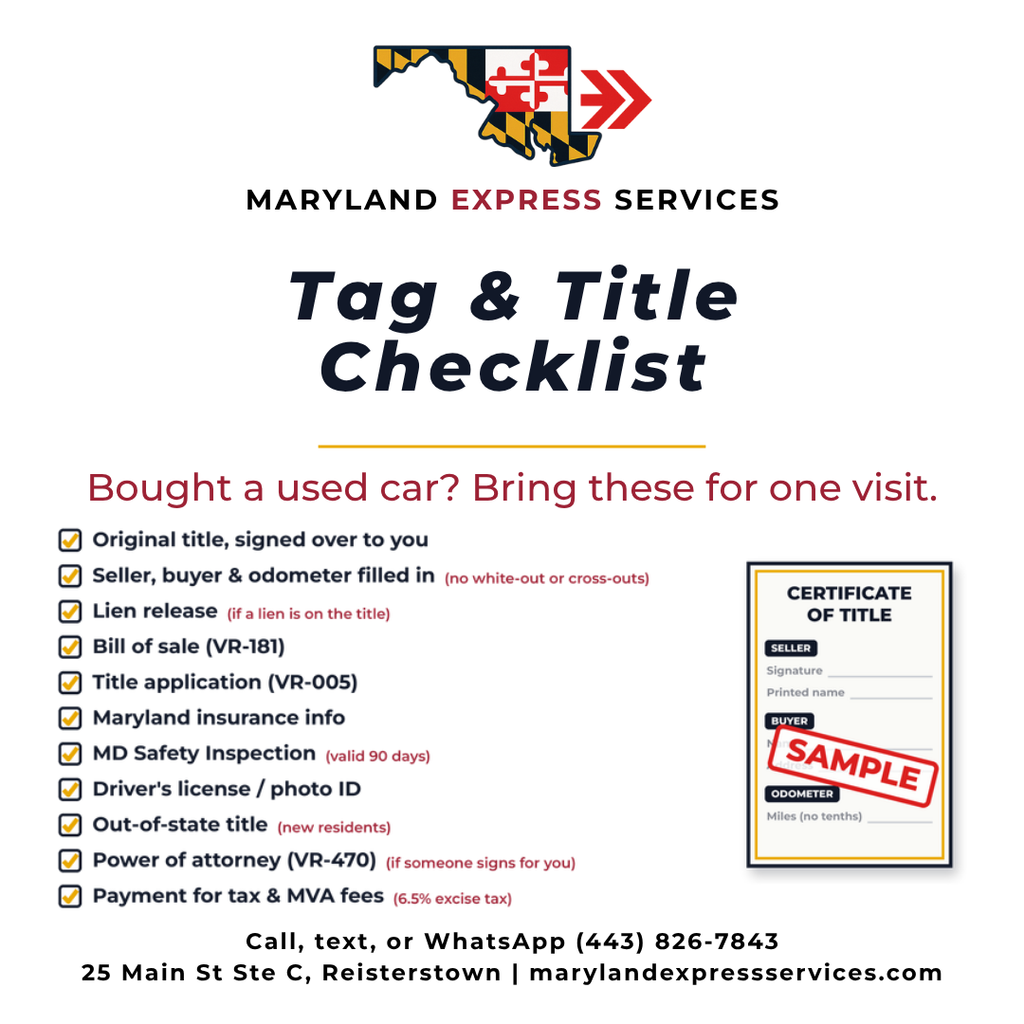
Almost every title and tag transaction starts with the same core documents:
- Photo ID: your driver’s license or other valid ID
- Proof of ownership: the original title signed over to you, or the manufacturer’s certificate of origin (MCO) for a brand-new vehicle
- A bill of sale (the MVA’s form VR-181 or your own)
- Maryland insurance information (company, NAIC number, policy number)
- A Maryland Safety Inspection Certificate issued in the last 90 days, for most used vehicles
- A lien release if the title shows a lien
- A completed Application for Certificate of Title (VR-005)
- Payment for Maryland’s 6.5% excise tax (unless an exemption applies) and MVA fees
Then add the items for your situation.
Checklist by situation
1. Private sale (Facebook Marketplace, Craigslist, a neighbor)
According to the MVA’s guide to Titling a Vehicle Bought from a Private Party, bring:
- ☐ The original title, properly assigned to you, with the seller’s signature, your name and address, the sale price, the date, and the odometer reading (no white-out)
- ☐ Lien release, if a lien is listed on the title
- ☐ Bill of sale (VR-181) showing the price you paid
- ☐ VR-005 title application
- ☐ Maryland insurance information
- ☐ Maryland Safety Inspection Certificate (valid 90 days)
- ☐ Valid photo ID
- ☐ Payment for excise tax and fees
- ☐ Proof of the price if you paid more than $500 below book value: the ad, your messages with the seller, or a bank record (see the $500 rule below)
- ☐ VR-470 power of attorney if someone else is signing for an owner
Before you pay the seller, check the car for MVA flags before you pay.
2. Dealer purchase (new or used, still no permanent tags)
A Maryland dealer submits the title application for you. An out-of-state dealer may not (Titling a Vehicle Bought From a Dealership). Ask the dealer whether the title application was already submitted. If it wasn’t, the MVA lists:
- ☐ VR-005 title application
- ☐ Proof of ownership from the dealer. For a new vehicle, that’s the manufacturer’s certificate of origin (MCO). For a used vehicle, it’s the title.
- ☐ The original dealer bill of sale, if applicable. The MVA’s VR-005A instructions say this ensures the trade-in allowance is properly deducted.
- ☐ Odometer disclosure statement
- ☐ Maryland Dealer Reassignment Form, if applicable
- ☐ Valid photo ID
- ☐ Lien information, if you financed
- ☐ Maryland insurance information
- ☐ Maryland Safety Inspection Certificate for a used vehicle
- ☐ Payment for taxes and fees
- ☐ Your temp tag and its paperwork
About temp tags: Under Transportation Article § 13-605, a dealer temporary registration expires when your permanent plates arrive or 60 days after it was issued, whichever comes first. The MVA may extend it by up to 30 days if reasonable conditions justify it. Don’t wait until the last week. Learn more about Maryland temp tags, ICD/ICDPUT pick-up tag flags, and dealer reassignment sales.
3. Out-of-state transfer or new Maryland resident
According to the MVA’s Title & Register Your Vehicle (new residents) page, you must title and register within 60 days of moving to Maryland. If you wait longer, you lose the credit for titling tax paid in your old state, and you could be cited for out-of-state registration. (Maryland’s new fines for out-of-state plates are now in effect.) Bring:
- ☐ Your out-of-state title
- ☐ If a lender or leasing company holds the title: their fax number, your account number, their mailing information, and your current registration card
- ☐ A valid Maryland driver’s license or proof of a Maryland home address
- ☐ Maryland Safety Inspection Certificate. This isn’t needed if you’re returning with a vehicle that was previously titled in Maryland in your name.
- ☐ Maryland insurance information
- ☐ VR-005, if you didn’t complete the MVA pre-application
- ☐ For a lease: a copy of the lease or a letter from the leasing company showing taxes paid to your previous state
- ☐ Payment for excise tax and fees
Coming from a state that doesn’t issue titles? The VR-005A instructions call for that state’s registration plus a bill of sale. See also excise tax after moving to Maryland.
4. Gift or inherited vehicle
A gift from a family member (Maryland-titled vehicle). According to the MVA’s Giving a Vehicle as a Gift page and the Application for Maryland Gift Certification (VR-103), bring:
- ☐ The Maryland title, with your name as the buyer, “GIFT” written in the sale price field (don’t leave it blank), the odometer reading, and the giver’s signature and date
- ☐ VR-103 Application for Maryland Gift Certification, signed by the giver and the receiver, who both certify that no money or other valuable consideration was exchanged
- ☐ Proof of relationship if your last names are different
- ☐ Lien release, or the lienholder’s written authorization to transfer the lien
- ☐ Your current registration card, if you’re transferring plates
- ☐ Maryland insurance information, photo ID, and VR-005 (or the application on the back of the title)
- ☐ Maryland Safety Inspection Certificate, unless the transfer is between spouses or between a parent and child, which is generally exempt
The family-transfer excise tax exemption. Under Transportation Article § 13-810(c), a Maryland-titled vehicle is exempt from excise tax when it’s given, with no money or other valuable consideration, to a spouse, child, grandchild, parent, sibling, grandparent, or parent-, son-, or daughter-in-law. The VR-103 also lists step-, adopted, and half relationships. A gift to a niece or nephew qualifies only if the aunt or uncle is at least 65 (the MVA uses form VR-299 when proof of that relationship isn’t available). The MVA notes that tax exemptions “are not automatic and must be documented.” Plates can be transferred for a $15 fee in certain spouse and parent/child transfers; other family gifts need new plates (VR-103 instructions). More: Maryland vehicle gifts and safety inspection.
An inherited vehicle (the owner has died). The MVA’s Handling a Loved One’s Vehicle After Death page splits this into situations:
- ☐ Surviving joint owner keeping the car: the title with the back completed, a certified copy of the death certificate (or the MVA letter you received), and a lien release or authorization if there’s a lien. No safety inspection is required when you keep the vehicle.
- ☐ Vehicle owned only by the person who died: the original letters of testamentary or administration with the Register of Wills’ raised seal. The MVA accepts only originals, and the administrator’s full name and address must be provided. The MVA suggests contacting the Register of Wills in the county where the person lived to confirm you have the right documents.
- ☐ Surviving spouse, small estate: if the person’s only property was no more than two vehicles and the spouse is the only heir, the spouse may be able to skip estate administration with the Application for Exemption from Estate Administration (VR-481). The spouse provides proof of marriage, the death certificate if applicable, and certifies that all debts and taxes are paid.
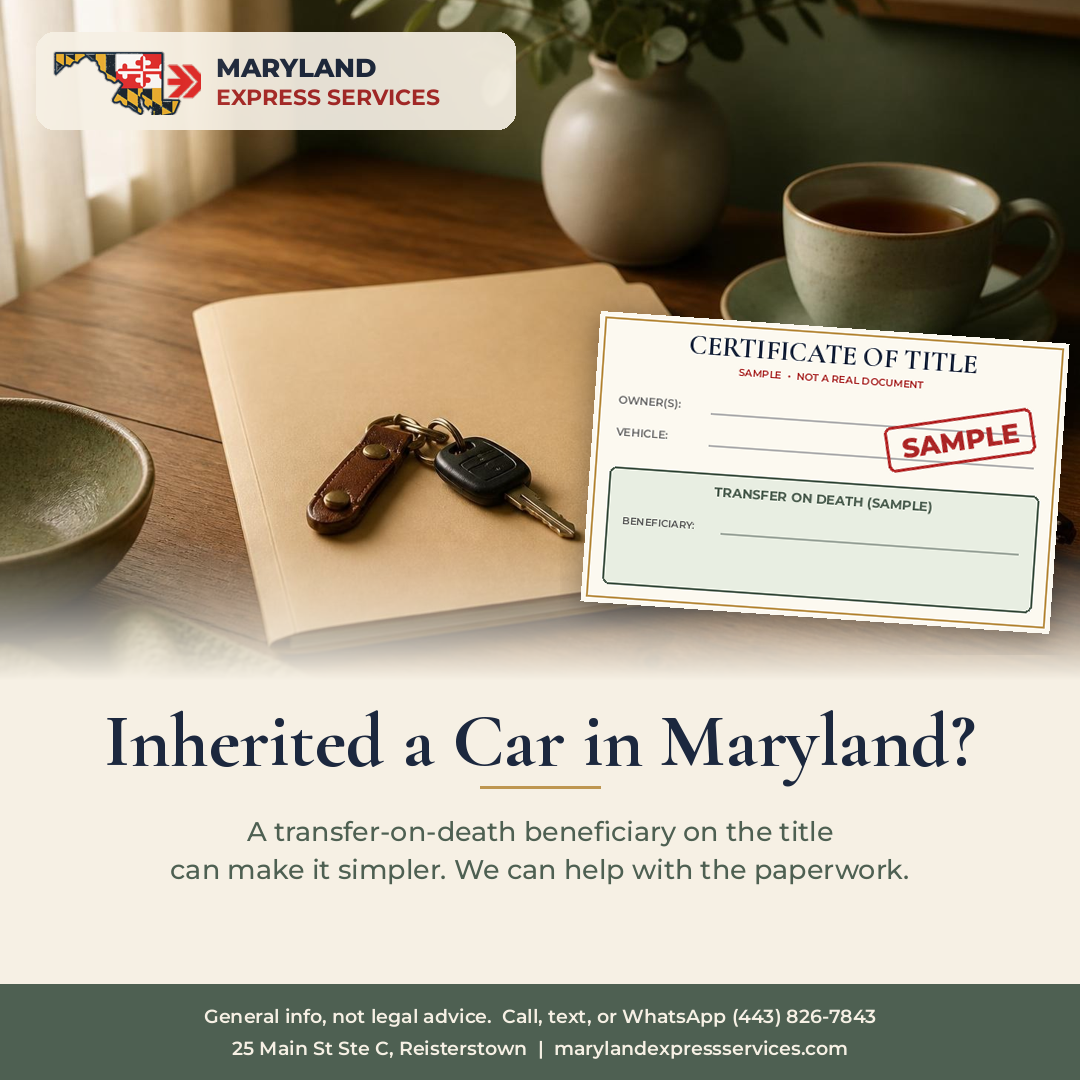
- ☐ Transfer-on-death (TOD) beneficiary on the title: the title plus a death certificate. The certificate isn’t needed if the MVA was already notified by the state health department. All liens must be satisfied, or the lienholder must give written permission. A TOD vehicle isn’t part of the estate, so letters of administration aren’t required.
- ☐ Transfer to an immediate family member: the title, the death certificate or MVA letter, a VR-103, a lien release, and proof of relationship if last names differ.
- ☐ Buying from an estate: the administrator or executor signs the title and provides the letters of administration. The MVA’s page says a VR-181 bill of sale signed by the administrators and buyers is required, and that page still says it must be notarized. Call us before you go so we can confirm the current requirement.
Excise tax: According to the MVA, no excise tax is due when a deceased person’s Maryland-titled vehicle is transferred to a surviving spouse, legal heir, legatee, or distributee (see also § 13-810(c)(4)). This area involves estate law, so if you’re unsure of your legal standing, the MVA suggests talking with an attorney or the Register of Wills. More: transferring a vehicle title after death and our vehicle transfer after death guide.
What each item means (and how to get it right)
Photo ID
The MVA asks for valid identification. The VR-005 asks for each applicant’s Maryland driver’s license or MDID number, including any co-owner. New residents need a valid Maryland driver’s license or proof of a Maryland home address.
The title or MCO, signed over the right way
For a used vehicle, the MVA wants the original title, properly assigned to you, with all required sections completed and any liens released. According to the MVA’s Buying a Vehicle page, the seller should complete every required section, record the correct sale price, write down the odometer reading, and sign and date the title. For a new vehicle, the proof of ownership is the manufacturer’s certificate of origin (MCO) (VR-005A).
- Make sure your name and the price are filled in. Under COMAR 11.15.14.05, the MVA will refuse the title if the buyer’s name is blank or the price is blank and you don’t have a bill of sale.
- No white-out, scratch-outs, or write-overs. The MVA says not to alter official documents. Under the same rule, the MVA will refuse the title if an error or alteration isn’t cleared up by a letter of explanation or certified statement. If the seller makes a mistake, stop and call us before anyone “fixes” it. More: what condition a title must be in.
- Odometer disclosure. Under the federal odometer rule, a 2011 or newer vehicle needs an odometer disclosure until it’s 20 years old, and a 2010 or older vehicle is exempt. If the title has no room, the MVA has an Odometer Disclosure Statement (VR-197).
Lien release
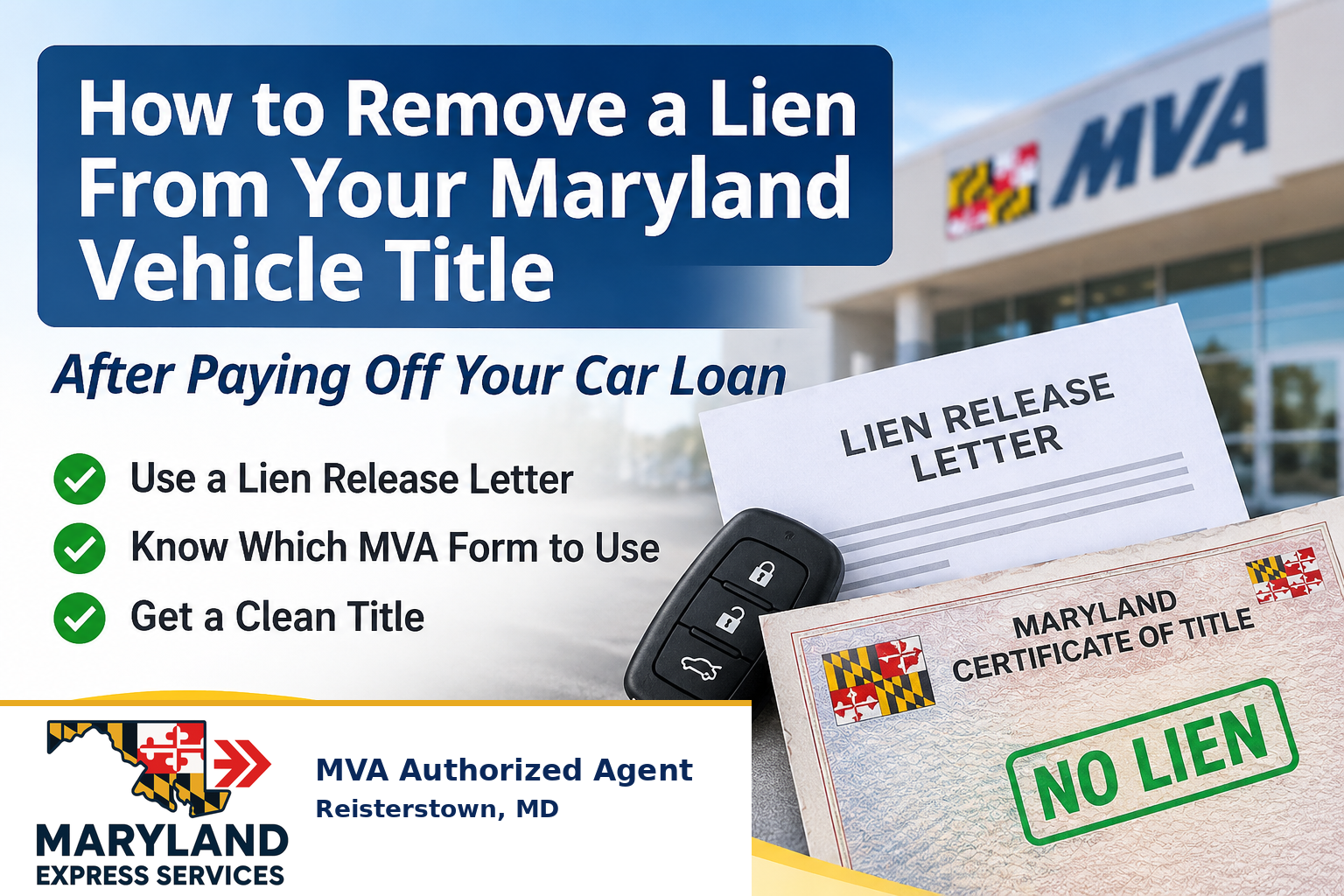
If the title lists a lienholder, COMAR 11.15.14.05 accepts the release on a Maryland Notice of Security Interest Filing form, on the title itself, in a letter on the lienholder’s letterhead, or by electronic transmission from an approved vendor. The VR-103 instructions add that whoever presents a lien release letter must show a state-issued photo ID. If you are financing, your lender goes in the lien section of the VR-005. If there’s no lien, write “NONE” there. The lien filing fee is $40 per lien. More: what to do after a loan payoff, and what to do if your lender no longer exists.
Bill of sale (VR-181), and the October 1, 2026 change
The MVA’s Bill of Sale (VR-181) records the vehicle, VIN, odometer reading, price, the reason for a below-market price if there is one, and the buyer’s and seller’s signatures. The current version (revised 10-26) has no notary section. The MVA’s Buying a Vehicle page says a bill of sale “is not always required, but it is strongly recommended.” The VR-005A instructions list “a properly assigned title and bill of sale” for used vehicles from a title state. Our advice: always bring one. More: Do you need a bill of sale in Maryland?
No more notary for newer vehicles. Chapter 119 of 2026 (Senate Bill 125) and its twin, HB 251 (Chapter 118), took effect October 1, 2026. They repealed the notarized bill of sale requirement. According to the MVA bulletin on the repeal, a notarized bill of sale is no longer required for vehicles less than 7 years old sold by a private party.
The $500 rule. For a privately sold vehicle less than 7 years old, the MVA compares your reported price with the vehicle’s NADA value:
- Within $500 of NADA: tax is figured on the price you reported.
- More than $500 below NADA: you can pay tax on the NADA value, or provide documentation that supports the lower price.
- Disputed value or no NADA value found: an MVA agent reviews the transaction.
The MVA says no list of acceptable evidence can be complete. Its examples include a bill of sale or records of the vehicle’s condition, a canceled check, a bank statement or loan documents, the printed ad or your messages with the seller about the price, and a listing from another national guide such as Kelley Blue Book or Price Digest.
Application for Certificate of Title (VR-005)
The VR-005 asks for your name, address, and license or MDID number; the vehicle’s year, make, model, and VIN; any lien (or “NONE”); the purchase price; the odometer reading; whether you want new tags, a tag transfer, a 30-day inspection plate, or title only; and your insurance company, NAIC number, and policy or binder number. We can help you fill it out at the counter.
Maryland insurance
You need Maryland auto insurance from a company licensed in Maryland before you register. According to the MVA’s Auto Insurance Requirements, the minimums are $30,000 per person and $60,000 per accident for bodily injury, and $15,000 for property damage. Add the car to your policy first. Then bring your insurance card or policy page so we can enter the company, NAIC number, and policy number. Insurers report coverage to the MVA electronically. The FR-19 (Maryland Insurance Certification) comes from your insurer when the MVA asks you for proof of insurance, for example after a records mismatch. See also registration and insurance in different names.
Maryland Safety Inspection Certificate
Under Transportation Article § 23-107, the MVA needs a valid inspection certificate before it titles and registers most used vehicles (Class L historic vehicles excluded). According to the MVA’s Maryland Safety Inspections page, the inspection must be done at a station licensed by the Maryland State Police, which sends the certificate to the MVA electronically. The certificate is valid for 90 days from the date it’s issued. If the car fails, you have 30 days (and up to 1,000 miles) to get the failed items rechecked.
Not inspected yet? You can get one 30-day temporary registration to drive to inspection with the Temporary Inspection Waiver (VR-129), which has a $50 non-refundable fee. You can also title the car now and register it later. More: when a safety inspection is and isn’t required and our 30-day temporary tag guide.
The VEIP emissions notice (after you register)
You don’t need an emissions test to get your title, and the safety inspection doesn’t include one. Baltimore County and Carroll County are both in the Vehicle Emissions Inspection Program. According to the MVA’s Vehicle Emissions Inspection page, the MVA sends a VEIP test notice a few months after you register a used vehicle (its pages say about three to four months). Used vehicles test every 2 years. The test is $30, or $26 at a self-service kiosk. If you have the previous owner’s VEIP certificate, you can send VEIP a copy to update your record. A missed deadline can block your next renewal and add late fees.
Power of attorney (VR-470), if someone else is signing
Under COMAR 11.15.14.05, the MVA will refuse the title if a seller’s or applicant’s signature was made under a power of attorney and that document isn’t provided. The MVA’s Restricted Power of Attorney (VR-470) covers titling and registration. A copy of every vehicle owner’s driver’s license must be attached.
Payment: excise tax and MVA fees
Excise tax is 6.5% (the rate since July 1, 2025). How the taxable value is figured depends on how you got the car (MVA Excise Tax page and VR-005A):
- From a licensed dealer: 6.5% of the full purchase price, less any trade-in allowance
- Private sale, 6 model years old or newer: 6.5% of the greater of the purchase price or the NADA “clean retail” value (adjusted for mileage), with the $500 rule above
- Private sale, 7 model years or older: 6.5% of the purchase price, with a minimum tax of $41.60 (which applies when the price is $640 or less)
- New residents who moved within the last 60 days, vehicle 6 model years or newer: the difference between your old state’s rate and 6.5%, applied to the NADA clean retail value, with a $100 minimum. If you moved more than 60 days ago, you pay 6.5% of that value. Vehicles 7 model years or older pay $41.60.
- Qualifying family gifts and inheritances: exempt, as described above
More: how Maryland figures vehicle excise tax.
State fees (MVA Fees & Payment Options page and VR-005A):
| MVA fee | Amount |
|---|---|
| New or used title certificate | $200 |
| Security interest (lien) filing, per lien | $40 |
| Passenger car registration, Class A, 1 year (includes the $40 EMS surcharge) | $120.50 (3,500 lbs or less), $125.50 (3,500–3,700 lbs), or $191.50 (over 3,700 lbs) |
| Plate transfer | $15 (plus any difference in registration fees) |
| Temporary registration | $50 |
| Electric vehicle annual surcharge | $125 (zero-emission) or $100 (plug-in hybrid) |
Fees are set by the State of Maryland and can change. Trucks, motorcycles, and trailers have different rates.
Common mistakes that cause a second trip
- The seller signed, but your name or the price is blank, and there’s no bill of sale
- White-out, scratch-outs, or a “corrected” title
- The seller isn’t the owner shown on the title. The MVA warns about curbstoners, unlicensed sellers who pose as private sellers.
- An old lien still on the title, with no release
- An expired inspection. The certificate is good for only 90 days.
- No insurance yet, or insurance on the wrong car or in a different name
- Paying well below book value with no proof. The notary is gone, but supporting documents still count.
- “GIFT” left off the price line, or a missing VR-103, on a family gift
- Copies instead of original letters of administration with the raised seal
- Someone signs for an owner without a VR-470 and copies of the owners’ licenses
- Letting a temp tag run out, or a new resident waiting past 60 days
Why come to Maryland Express Services?
Maryland Express Services LLC is an MVA-licensed private tag and title service agent in Reisterstown. We’re not the MVA. We’re a local, authorized business offering tag and title services to customers from Reisterstown, Owings Mills, Glyndon, Finksburg, and across Baltimore County, and we’re rated 4.9 stars on Google. Not sure your paperwork is complete? Call or text us before you come in and we’ll go over it with you. You can also reach us through our contact page.
Frequently asked questions
What do I need to title a car I bought on Facebook Marketplace in Maryland?
Bring the original title signed over to you with the seller, buyer, price, and odometer sections completed, a lien release if a lien is listed, a bill of sale, a completed Application for Certificate of Title (VR-005), Maryland insurance information, a Maryland Safety Inspection Certificate from the last 90 days, valid photo ID, and payment for the 6.5% excise tax and MVA fees.
Do I still need a notarized bill of sale in Maryland?
Not for most newer vehicles. As of October 1, 2026, a notarized bill of sale is no longer required for vehicles less than 7 years old sold by a private party. If your price is more than $500 below the NADA value, you can pay tax on the NADA value or bring documents that support the lower price, such as a bill of sale, proof of payment, the ad, or messages with the seller.
What do I bring if I bought a new car from a dealer and still don’t have plates?
Ask the dealer first, because Maryland dealers normally submit the title application. If the dealer did not, bring a VR-005, the manufacturer’s certificate of origin (MCO), the original dealer bill of sale, an odometer disclosure statement, valid ID, lien information if financed, Maryland insurance information, and payment. Dealer temp tags expire 60 days after they are issued or when permanent plates arrive, whichever comes first.
How long is a Maryland safety inspection certificate good for?
According to the MVA and Transportation Article section 23-107, the certificate is valid for 90 days from the date it is issued. Title and register the vehicle before it expires.
Is a car gifted by a family member exempt from Maryland excise tax?
It can be. A Maryland-titled vehicle given to an eligible family member, such as a spouse, child, parent, sibling, grandparent, grandchild, or in-law, with no money or other valuable consideration involved, is exempt under Transportation Article section 13-810. Write GIFT in the price field on the title and bring the Application for Maryland Gift Certification (VR-103), plus proof of relationship if last names differ.
What do I need to transfer a car from someone who passed away?
It depends on how the car was titled. Generally bring the title, a certified death certificate or the MVA letter, and a lien release if there is a lien. If the car was owned only by the person who died, the MVA requires the original letters of testamentary or administration with the Register of Wills’ raised seal. A surviving spouse may qualify for form VR-481 if the estate was no more than two vehicles, and a named transfer-on-death beneficiary needs the death certificate.
What if the seller made a mistake or used white-out on the title?
The MVA says not to alter official documents. Under COMAR 11.15.14.05, the MVA will refuse to issue a title if there is an error or alteration that a letter of explanation or certified statement does not clear up. Contact us before anyone tries to fix the title.
I just moved to Maryland. What do I bring?
Bring your out-of-state title (or your lienholder’s fax number, account number, and mailing information if a lender holds it), a valid Maryland driver’s license or proof of a Maryland address, a Maryland Safety Inspection Certificate, Maryland insurance information, a completed VR-005, and payment. Title and register within 60 days of moving to keep any credit for tax paid in your previous state.
Ready to get your tags?
Bought a car privately or from a dealer, just moved here, or got a car from family? Bring this checklist to our Reisterstown office and we’ll take it from there, seven days a week.
Maryland Express Services LLC
25 Main St Ste C, Reisterstown, MD 21136
- Call, text, or WhatsApp (443) 826-7843
- Fax (410) 465-1054
Contact Us
Mon–Fri 9 AM–9 PM · Sat 9:30 AM–8 PM · Sun 10 AM–7 PM
Maryland Express Services LLC is an MVA-licensed title service agent, not the Maryland Motor Vehicle Administration. This post is general information based on mva.maryland.gov, MVA forms, and Maryland law as of October 2026, not legal or tax advice. Fees and rules can change, so check the MVA website for the latest.