
Short answer: when your car is totaled in Maryland, what happens depends on who ends up with the car and how the insurer classifies it. If the insurer takes it, the insurer gets a salvage certificate, and you return your plates or, if eligible, transfer them to another vehicle. If you keep the car, the MVA records it as salvage and sends you a notice that tells you what comes next. Either way, keep your required insurance active until your plates are officially returned or an eligible transfer is complete with coverage in place.
It’s the season for it: Maryland’s Department of Natural Resources says deer movement picks up through the fall breeding season, and the Maryland Insurance Administration (MIA) calls mid-October to mid-December a peak time for deer-car collisions. This article is general information, not legal or insurance advice.
Car totaled and have a plate or title question?
Visit MES Tag & Title in Reisterstown, open 7 days a week. Call, text, or WhatsApp (443) 826-7843.
What “total loss” and “salvage” mean in Maryland
Under Transportation Article § 11-152, a vehicle is “salvage” when the cost to repair it for legal highway use is more than 75% of its fair market value before the damage, or when an insurance company acquires it in a claim settlement. Under § 13-506, towing, storage, rental and cosmetic repairs don’t count toward that repair cost, and the insurer’s paperwork states the car’s category: repairable with repair cost over 75% of value, flood damaged, parts only, or stolen. That category drives what happens next. A fifth category under § 13-506(c)(2)(ii) covers a vehicle an insurer acquires in a claim settlement even though the repair cost is 75% or less of its pre-loss fair market value: the insurer still applies for a salvage certificate, submitting the title with its application, and if the vehicle is later retitled, § 13-507 requires an “X-Salvage” notation.
On the claim side, the MIA’s Understanding Total Loss page says the settlement reflects the car’s actual cash value right before the loss, minus your deductible, and must include applicable taxes and registration fees. If you keep the car, the settlement is reduced by its salvage value.
If the insurance company takes the car
You sign the car over, and under § 13-506 the insurer applies for a salvage certificate in its own name within 10 days after settlement. Your part:
- Sign over the title as your insurer instructs.
- Take your plates and personal items, including any E-ZPass transponder, before the car leaves your hands.
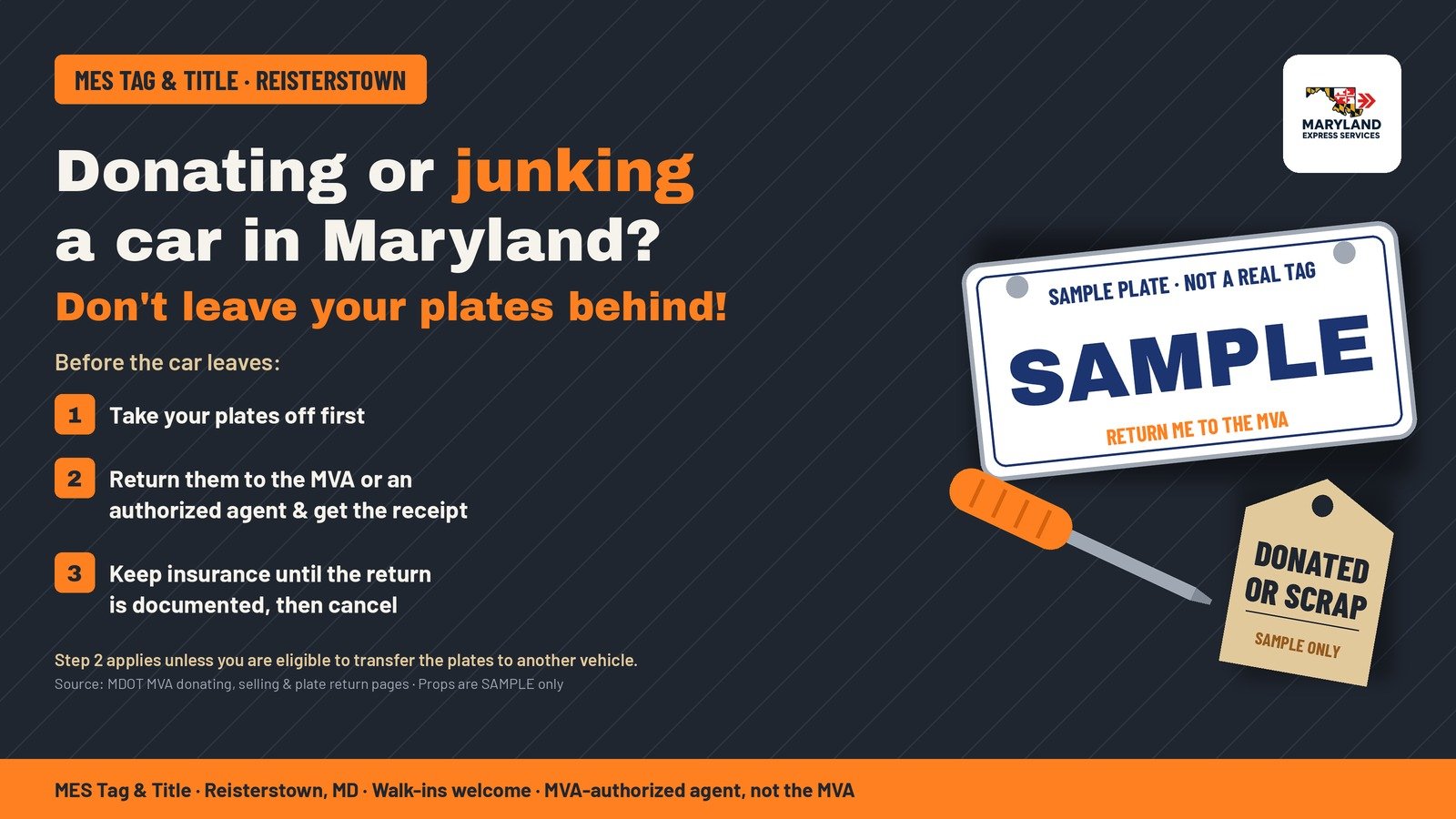
- Return the plates, or transfer them if you’re eligible.
- Keep your insurance active until the plates are officially returned or transferred.
If you keep the car: three different situations
Under § 13-506.1, the insurer must notify the MVA, and the MVA records the car as salvage (see also the MVA’s Owner Retention Application, VR-028). Not every total-loss vehicle follows the same inspection process. There are three groups:
1. Owner-kept repairable or flood-damaged vehicles: 90-day safety inspection notice
The MVA sends you a notice that the registration will be suspended unless you show proof the car passed a Maryland safety inspection within 90 days of the notice date. This is a standard safety inspection at a licensed inspection station. The Maryland State Police Salvage Vehicles page says: “If you have received an MVA form VR-310 stating your vehicle needs to pass a safety inspection within 90 days, you do not need a salvage inspection.” After the inspection, the MVA issues a new branded title under § 13-507, such as “rebuilt salvage” or “flood damaged.”
2. Salvage-certificate vehicles being rebuilt: State Police salvage inspection
A rebuilt vehicle with a salvage certificate, such as one an insurer took and later sold, generally must pass a Maryland State Police salvage inspection before it can be titled again; the State Police notes that a vehicle already salvage-inspected in another state may not need another. A State Police certified salvage inspector checks the vehicle identification numbers and verifies that no stolen parts were used. The vehicle must be fully repaired and roadworthy, and the salvage certificate must be in your name. The salvage inspection and the regular Maryland safety inspection are separate requirements: the MVA says salvage inspections “are separate from standard safety inspections,” and § 13-507 requires proof of both before titling. After passing the salvage inspection, eligible owners may apply for temporary documents so the regular safety inspection can be completed: the State Police says, “You can then apply for a temporary title and registration at the MVA,” subject to MVA requirements. This sequence applies to salvage-certificate vehicles, not to owner-kept repairable vehicles with a 90-day safety inspection notice.
3. Non-rebuildable (parts-only) vehicles: registration suspended, plates returned
The MVA issues a salvage certificate, suspends the registration and directs that the plates be returned immediately. Under § 13-507, a parts-only vehicle can never be retitled.
Can you drive a totaled car you kept?
Don’t assume so. The 90-day notice is a deadline for proof of a safety inspection; it doesn’t by itself authorize driving. Whether a vehicle can legally be driven depends on its actual registration status, its salvage classification, whether required insurance is in force, and the instructions the MVA gives you. The MVA’s Titling Salvaged Vehicles page says a salvage vehicle can’t be registered or driven until it’s rebuilt, inspected and approved, and a parts-only vehicle’s registration is suspended. If your notice is unclear, ask the MVA before you drive. Our salvage and rebuilt title guide covers rebuilt titles.
The plates: return or transfer
The MVA’s Returning Maryland License Plates page says you must return plates you no longer need, and after a total loss you may keep them only to transfer them to another vehicle you own.
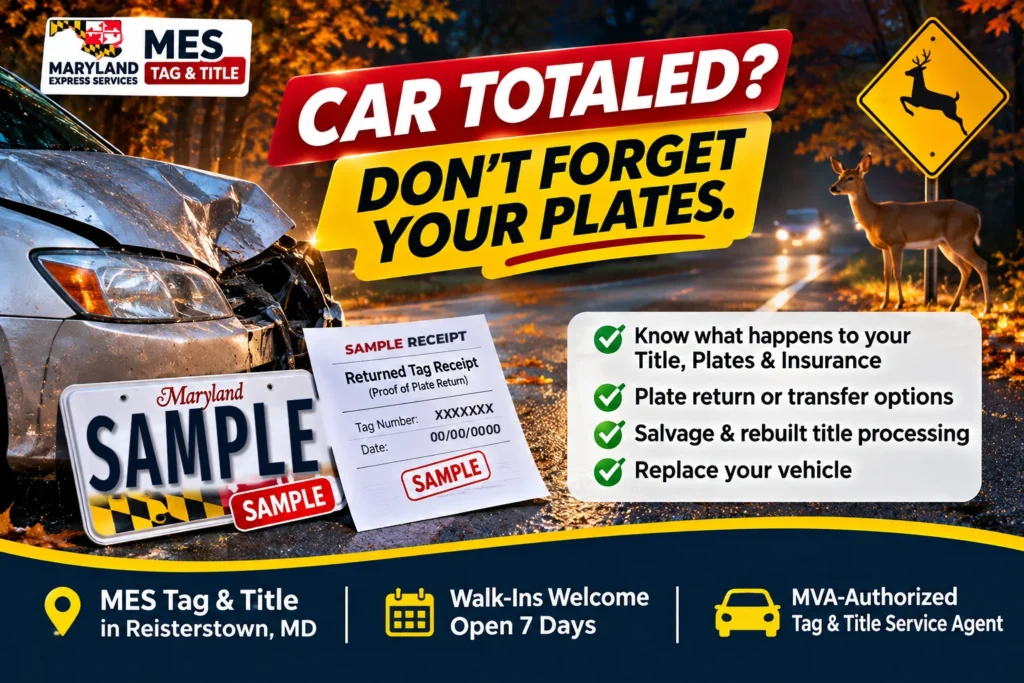
- Returning them: at MES Tag & Title, we’ll return them and hand you an official MVA Returned Tag Receipt on the spot. Our plate return guide compares the options.
- Transferring them: the MVA License Plates page says you may be able to transfer plates if the new vehicle is titled in the same name, it’s Class A, M or E with the same plate type, and you “sold, traded, junked, or disposed of the vehicle the plates were on.” Other MVA eligibility rules may apply. Transfers aren’t limited to cases where the insurer took the car, but a transfer from a car you kept as salvage isn’t guaranteed, so ask before you plan on it. See how tag transfers work.
- Parts-only car you kept: return the plates right away, as the MVA directs.
Lost a plate in the crash? See our lost license plate post.
Insurance and car loans
Keep the required Maryland insurance on the vehicle active until your plates have been officially returned and you have the receipt, or until an eligible transfer is complete with coverage on the replacement vehicle. The MVA says to keep insurance active until you receive your tag return receipt. A gap while plates are still active can lead to insurance violation penalties; see our insurance lapse guide.
If you still owe money on the car, the settlement does not automatically pay off the loan. The MIA’s GAP insurance page explains that your policy pays the car’s actual cash value, not the loan balance; if you owe more, you’re responsible for the rest. Optional GAP coverage, if you have it, generally pays the difference. Check with both your lender and insurer about:
- Who receives the settlement payment and how much of the loan it covers
- Whether a balance will remain, and whether GAP coverage applies
- How and when the lender will release its lien
Replacing the car
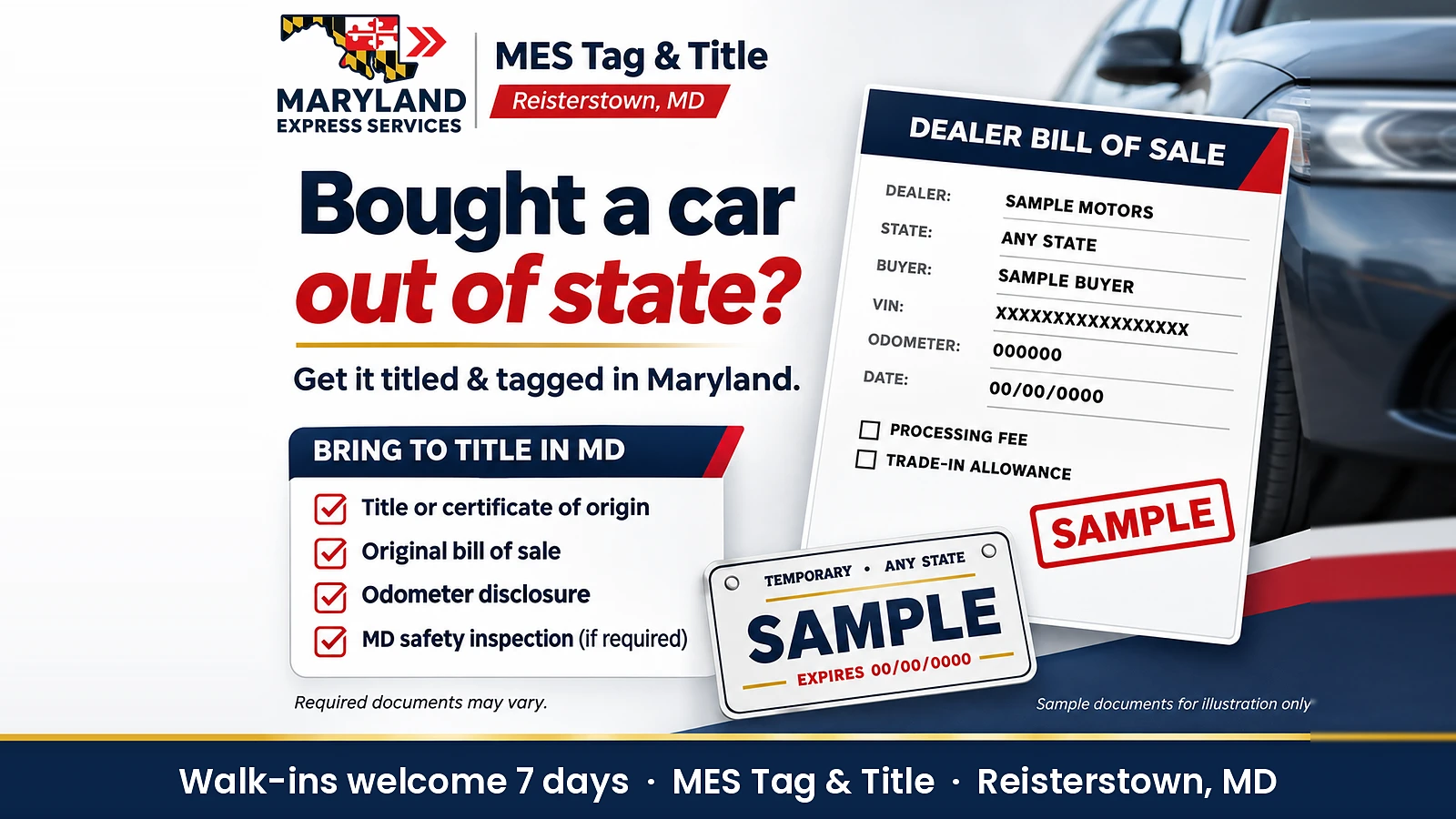
- Our tag and title checklist lists what to bring, including the signed title, bill of sale, safety inspection certificate if required, proof of insurance and ID.
- Title fees and excise tax apply to the new vehicle; see our Maryland state fees breakdown.
- Before buying privately, check the vehicle for MVA flags.
How MES Tag & Title can help
At our Reisterstown office, MES Tag & Title offers:
- Maryland license plate returns with an official MVA Returned Tag Receipt issued on the spot
- Vehicle flag inquiries
- Eligible license plate transfers
- Title and registration processing for replacement vehicles
- Eligible salvage and rebuilt title processing through the MVA Business Portal, following any required inspections
How our salvage and rebuilt title service works: MES Tag & Title processes eligible salvage and rebuilt title transactions through the MDOT MVA Business Portal after any required salvage inspection has been completed. Following MVA processing and approval, titles are mailed to customers, and MES picks up applicable license plates from the MVA for customer delivery.
Not every total-loss vehicle follows the same salvage inspection process, and some don’t need one at all. Bring your MVA notice and documents, and we’ll review them. MES doesn’t perform inspections and cannot guarantee MVA approval, and we don’t handle insurance claims or tow, haul or buy vehicles.
Maryland Express Services provides in-person Tag & Title services. Please bring your required documents to our office for review and assistance. Walk-ins are welcome—no appointment necessary.
Frequently asked questions
Do I have to return my plates if my car is totaled in Maryland?
If you no longer need them, yes. The MVA lets you keep them only to transfer them to another vehicle you own, subject to its eligibility rules. If you kept a parts-only car, the MVA directs you to return the plates immediately.
When can I cancel my insurance after a total loss?
After your plates have been officially returned and you have the tag return receipt, or after an eligible transfer is complete with coverage on the replacement vehicle. The MVA says to keep your insurance active until you receive the receipt.
Can I drive a totaled car I kept during the 90-day inspection period?
Not automatically. The 90-day notice sets a deadline for a safety inspection; it doesn’t authorize driving by itself. It depends on your registration status, salvage classification, insurance coverage and MVA instructions, so check with the MVA first.
Does every totaled car need a State Police salvage inspection?
No. The Maryland State Police says that if you received MVA Form VR-310 requiring a safety inspection within 90 days, you don’t need a salvage inspection. A salvage inspection applies to rebuilding a vehicle with a salvage certificate, and parts-only vehicles can’t be retitled at all.
Does the insurance settlement pay off my car loan?
Not automatically. The settlement is based on the car’s actual cash value, and if you owe more, you’re responsible for the balance unless GAP coverage applies. Check with your lender and insurer about the payment, the lien release and any GAP coverage.
Does hitting a deer count as collision or comprehensive?
The Maryland Insurance Administration lists animal strikes under comprehensive coverage, which is optional. Ask your insurer how your own policy applies.
Can MES Tag & Title help after my car is totaled?
Yes. We return plates with an official MVA Returned Tag Receipt issued on the spot, handle flag inquiries and eligible plate transfers, process title and registration for replacement vehicles, and process eligible salvage and rebuilt titles after any required inspections. We don’t perform inspections or guarantee MVA approval.
Sources
- Maryland Transportation Article § 11-152 (definition of salvage)
- Maryland Transportation Article § 13-506 (salvage certificates)
- Maryland Transportation Article § 13-506.1 (owner-retained salvage vehicles)
- Maryland Transportation Article § 13-507 (titles for salvage vehicles)
- MVA: Application for a Salvage Certificate/Owner Retention (VR-028)
- MVA: Titling Salvaged Vehicles in Maryland
- MVA: Returning Maryland License Plates
- MVA: License Plates (transferring plates)
- Maryland State Police: Salvage Vehicles
- Maryland State Police: Vehicle Inspections
- Maryland Insurance Administration: Understanding Total Loss
- Maryland Insurance Administration: GAP Insurance
- Maryland Insurance Administration: Deer-Vehicle Collisions
Maryland Express Services is a privately operated MDOT MVA-authorized Tag & Title agent and is not the Maryland Motor Vehicle Administration. MES does not provide legal advice.