
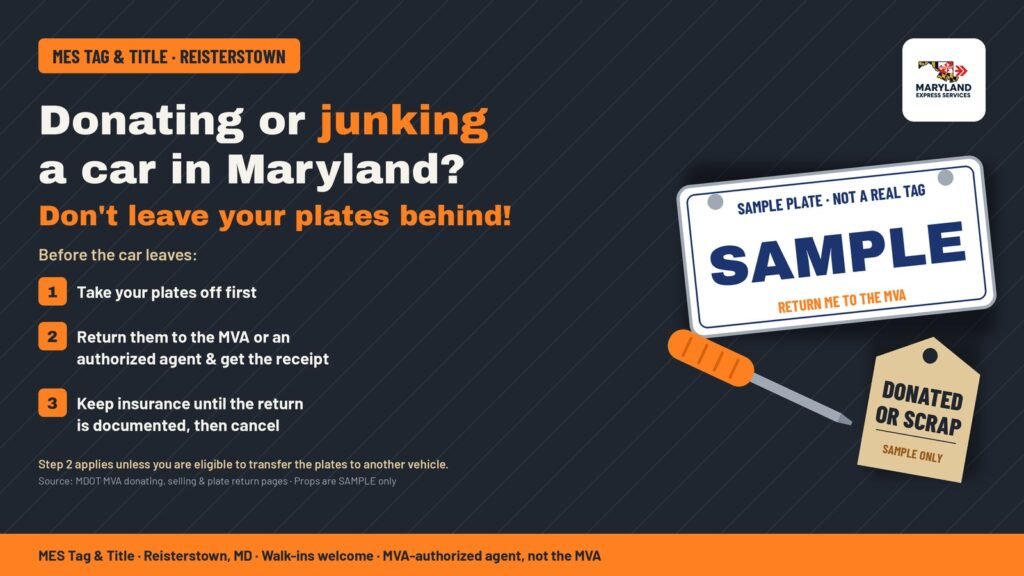
Short answer: if you donate a car in Maryland to a charity, that is a different transaction from selling it to a licensed salvage or recycling facility. Both transactions require proper ownership documentation. Donating a vehicle generally requires a properly assigned title, while certain transfers to licensed dismantlers or scrap processors may qualify for alternative ownership documentation under Maryland law. Either way, remove your plates before the car leaves, return them to the MVA or an authorized agent (unless you are eligible to transfer them to another vehicle), and keep your Maryland insurance active until the return is documented. Most of the problems we see come from skipping one of those steps, not from the donation or the sale itself.
Late in the year, many people clear out a car that failed inspection, sat all summer, or just isn’t worth repairing. Some want to donate it before December 31; others want to sell it for scrap before winter. Either way, the paperwork protects you after the car is gone. MES Tag & Title (Maryland Express Services LLC) in Reisterstown is a privately operated MDOT MVA-authorized Tag & Title agent, not the MVA. We handle the plate and title paperwork side; we do not tow, pick up, buy or scrap vehicles. This guide is general information, not legal or tax advice.
Getting rid of an old car?
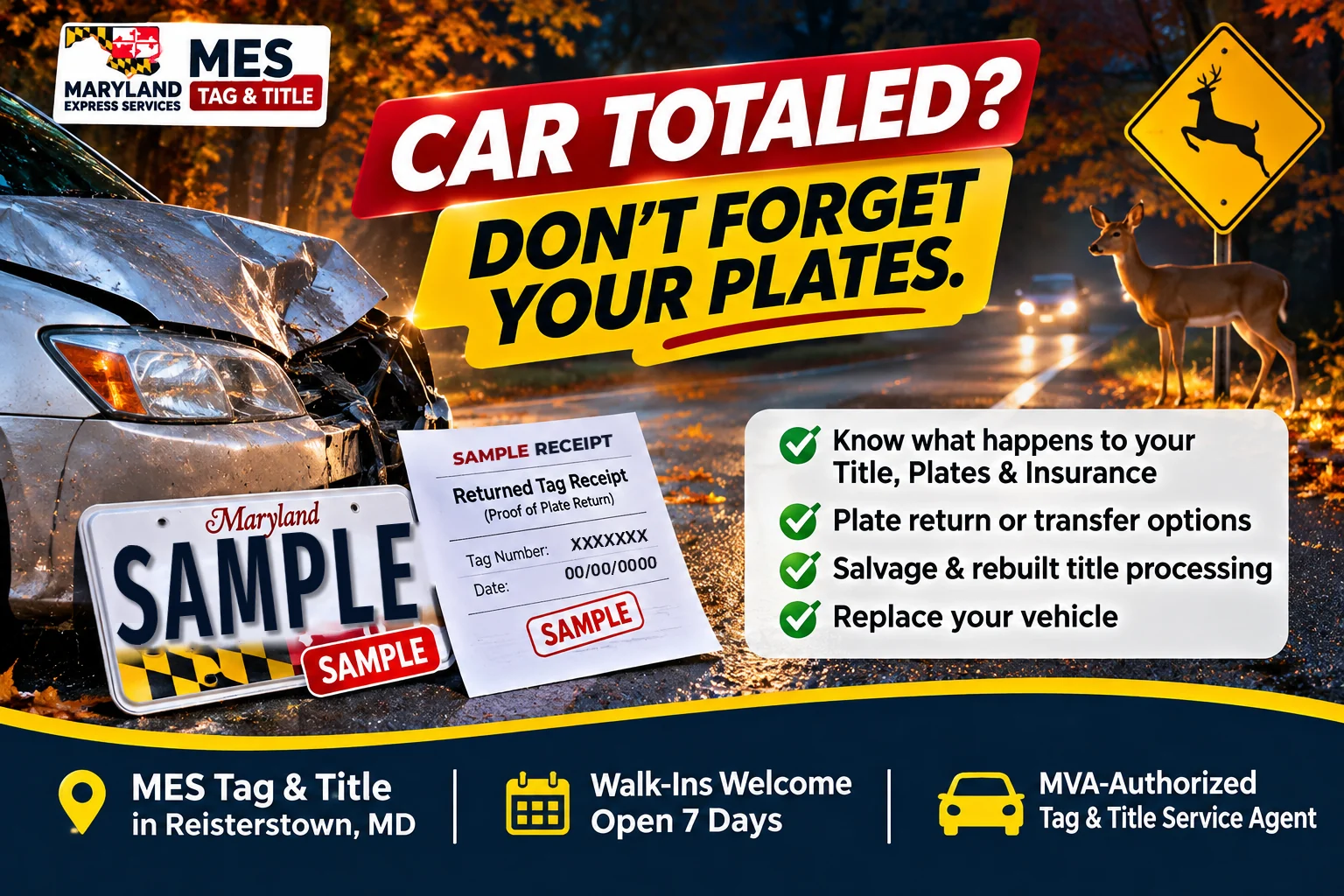
Walk in to MES Tag & Title in Reisterstown with your plates. We return them and give you an official MVA Returned Tag Receipt on the spot, so your plate return is documented before you cancel insurance. Walk-ins welcome 7 days a week. Call, text, or WhatsApp (443) 826-7843.
Donating vs. junking: two different transactions
Before you sign anything, decide which one you are doing:
- Donating to a charity. You give the car to a charitable organization. The charity becomes the new owner and goes on the title as the buyer, even if it later sells the car through a licensed dealer or for scrap. Depending on IRS rules, you may be able to claim a tax deduction.
- Selling or transferring to a licensed salvage or recycling facility. You sell or transfer the car to an automotive dismantler and recycler or a scrap processor, usually so it can be dismantled for parts or scrapped. This is a sale, not a charitable gift, so the IRS vehicle donation rules don’t apply. The MVA says businesses that dismantle, crush, shred or scrap vehicles in Maryland must be licensed by the MVA, so ask for the facility’s license information before you hand over the car.
Before you hand over the car: check the title
The MVA’s Donating a Vehicle page says you need a valid Certificate of Title to donate a vehicle, and the title must be in your name, match the vehicle’s VIN, and be free of liens or show a lien release. The MVA’s Selling a Vehicle page sets the same starting point for a sale: a valid title in your name, any lien released, and the VIN, owner names and address checked for errors.
Three common snags:
- The title is lost or damaged. Request a duplicate before you donate or sell. Our guide to a duplicate Maryland title explains the process.
- There is still a lien on the title. The lien has to be released first. See removing a lien from a Maryland title, and if the lender no longer exists, what to do with no lien release letter.
- The owner has died. If the titled owner has passed away, the required transfer documents depend on the ownership arrangement, any designated beneficiary, and applicable estate requirements. Review our Maryland vehicle title transfer after death guide before donating or selling the vehicle.
How to donate a car in Maryland
Step 1: Pick a real charity and be careful with pressure
The MVA advises making sure the organization is a recognized charitable organization. It notes that some charities work with licensed dealers to sell donated cars, which is allowed as long as the paperwork is done correctly. The MVA also says to be cautious if someone pressures you to donate quickly, can’t explain how the car will be used, or asks you to leave the title blank.
Step 2: Assign the title to the charity
On the Certificate of Title, the MVA’s donation steps are to enter the charity’s name as the buyer, record the odometer reading (the MVA notes federal law requires it), and sign and date the title exactly as your name appears. If more than one owner is listed, the MVA’s selling page says all owners must sign unless the title shows “OR.” The MVA is clear on one point: do not leave the buyer section blank. A blank buyer line leaves an “open” title, and the MVA says you are responsible for the vehicle until the title is properly transferred.
Step 3: Get a receipt
Ask the charity for a donation receipt, or give it a bill of sale that shows your name, the charity’s name, the vehicle information and the date. The MVA notes this protects you and may be needed for tax purposes. The MVA also says the charity or its authorized dealer is responsible for inspection, titling and resale after the transfer.
Step 4: Understand the tax rules before you count on a deduction
A charitable deduction for a donated vehicle depends on IRS requirements, and it can be very different from the car’s estimated market value or a pricing-guide number. According to IRS Publication 4303, A Donor’s Guide to Vehicle Donation, and IRS Publication 526, Charitable Contributions:
- You can deduct charitable contributions only if you itemize deductions, and the organization must be a qualified charity.
- If you claim more than $500 and the charity sells the car, your deduction is generally limited to the gross proceeds from the charity’s sale, not the value you estimated.
- Limited exceptions can allow a deduction based on fair market value, such as when the charity certifies it will make significant use of the vehicle, materially improve it, or give or sell it to a needy individual at well below market value. If the charity sells the car for $500 or less, a special rule generally limits the deduction to the lesser of the car’s fair market value or $500.
- For a deduction over $500, you generally need a written acknowledgment from the charity, often Form 1098-C, within 30 days of the sale (or of the donation, if an exception applies), and you attach it to your return.
- If you claim more than $500, you generally must also file Form 8283, Noncash Charitable Contributions, with your return (usually Section A; some deductions over $5,000 require Section B and a written appraisal).
MES does not give tax advice. Talk to a qualified tax professional before you rely on a deduction.
Step 5: Take your plates off
Remove your plates before you give the vehicle to the charity. Maryland plates stay with the owner, not the vehicle.
How to junk a car: selling it to a licensed salvage or recycling facility
Assign the title to the facility
A licensed automotive dismantler and recycler or scrap processor needs proof of ownership too. Under Transportation Article § 15-507, a person who transfers a vehicle to one of these businesses must execute an assignment and warranty of title and deliver the certificate of title (or other documentary evidence of ownership the MVA accepts) at the time of the transfer.
On the back of the title, the MVA’s selling page lists what a seller fills in: the buyer’s name and address (here, the facility), the sale price, the odometer reading, the signature of every owner (unless the title shows “OR”) and the date of the sale. Don’t leave any section blank, and keep a copy of the front and back of the signed title along with a bill of sale or the facility’s receipt.
If the title is missing: what Form VR-453 does and doesn’t do
Form VR-453 is not a general substitute for a vehicle title. The MVA’s Affidavit of Ownership for Transfer of a Vehicle to an Automotive Dismantler and Recycler or Scrap Processor (Form VR-453) is one of the ownership documents listed in COMAR 11.12.03.07, and it applies only in narrow circumstances:
- Only for a transfer to a licensed automotive dismantler and recycler or scrap processor, and only so the vehicle can be dismantled, destroyed or scrapped.
- Only when the Certificate of Title is unavailable. The owner, or the owner’s agent, certifies under oath that the title can’t be provided.
- Only for the owner shown in MVA records. COMAR ties the Affidavit of Ownership to a person listed in MVA records as the sole owner, or that owner’s agent. The form requires copies of the owner’s driver’s license and the vehicle’s registration card or MVA vehicle record, and it says a jointly titled vehicle needs consent and documentation from all owners.
The form’s own limits are just as important: a vehicle transferred with VR-453 may not be retitled or assigned; it may only be dismantled, destroyed or scrapped. You can’t use it to donate a car to a charity, sell it to a private buyer, or trade it in. Ask the facility in advance which ownership documents it will accept.
One other narrow option exists: under Transportation Article § 25-209, an owner whose title is lost, destroyed or defective may apply to the local law enforcement agency for a certificate of authority to transfer the car to a dismantler or scrap processor.
If there is any chance the car could be fixed and driven again, sold to a private buyer or donated, getting a duplicate title first keeps every option open. If the car was declared a total loss by an insurer, the salvage rules apply instead; see our salvage and rebuilt title guide.
Take your plates off before the car leaves
Maryland law is specific here: under Transportation Article § 13-505, when you transfer a car that is going to be scrapped, dismantled or destroyed, you must immediately return the registration card and plates to the MVA for cancellation, unless the plates are transferred to another vehicle.
After the car is gone: plates first, insurance second
This is the step that costs people money. The MVA’s Returning Maryland License Plates page says you must return your plates when you sell, trade or junk a vehicle, and to keep your insurance active until you receive your tag return receipt. Keep your Maryland insurance in place until the plates have been returned and the return is documented, then cancel. If coverage ends while the plates are still active, the MVA can assess uninsured penalties. Our post on insurance lapse in Maryland explains how those work.
You have two choices for the plates:
- Return them to the MVA or an authorized agent. You can use an MVA branch counter, an MVA 24-hour tag return box with Form VR-027 (the MVA says to allow 72 hours, business days, before searching for the receipt in its system), or an MVA-authorized Tag & Title agent. At MES Tag & Title, walk in with your plates and we give you an official MVA Returned Tag Receipt on the spot. Our plate return guide compares the options.
- Move them to another car, if eligible. If you are replacing the car, you may be able to put the same plates on the new one. See transferring tags to a new car.
Keep copies of the front and back of the signed title, the donation receipt or bill of sale, and the plate return receipt. Our checklist for what to do after selling a car covers the paperwork worth saving.
How MES Tag & Title can help
MES Tag & Title prepares and submits the paperwork; the MVA processes, approves and issues. When you are getting rid of a car, we can:
- Return your plates while you wait and hand you an official MVA Returned Tag Receipt, so you have documentation before you call your insurance company.
- Help with eligible duplicate title applications and related vehicle title paperwork before the car leaves.
We do not tow, collect, buy or junk vehicles; the charity or the licensed facility arranges the vehicle itself. Maryland Express Services provides in-person Tag & Title services. Please bring your required documents to our office for review and assistance. Walk-ins are welcome—no appointment necessary.
Donating vs. junking: what’s the same and what’s different
| Donating to a charity | Selling to a licensed salvage or recycling facility | |
|---|---|---|
| What it is | A charitable gift | A sale or transfer for dismantling or scrap |
| Who goes on the title | The charity’s name as the buyer | The facility’s name and address as the buyer |
| If the title is missing | Get a duplicate title first | Duplicate title, or the limited VR-453 affidavit or certificate-of-authority options |
| Paper to keep | Donation receipt or bill of sale; Form 1098-C or other IRS acknowledgment if you claim a deduction | Bill of sale or the facility’s receipt |
| Tax deduction | Possible, subject to IRS rules | No (it’s a sale, not a donation) |
| Plates | Remove, then return or transfer if eligible | Remove, then return or transfer if eligible |
| Insurance | Keep until the plate return is documented | Keep until the plate return is documented |
Frequently asked questions
Do I need a title to donate a car in Maryland?
Yes. The MVA says you need a valid Certificate of Title in your name that matches the VIN and is free of liens or shows a lien release. If yours is lost, request a duplicate title before you donate.
Should I leave the buyer section blank if the charity asks me to?
No. The MVA says not to leave the buyer section blank. Enter the charity’s name as the buyer, record the odometer reading, and sign and date the title exactly as your name appears.
Is donating a car the same as junking it?
No. Donating is a gift to a charity, which goes on the title as the buyer and may lead to a tax deduction under IRS rules. Junking is a sale or transfer to a licensed automotive dismantler and recycler or scrap processor, usually for parts or scrap, and it is not a charitable donation.
Can I junk a car in Maryland without a title?
Sometimes, in narrow cases. If the title is unavailable and you are the owner shown in MVA records, a licensed dismantler or scrap processor may accept Form VR-453, an Affidavit of Ownership, with copies of your driver’s license and registration card or MVA vehicle record. A car transferred that way may only be dismantled, destroyed or scrapped, never retitled. Another option is a certificate of authority from local law enforcement.
Can I use Form VR-453 instead of a title to donate a car or sell it to a private buyer?
No. VR-453 is not a general substitute for a title. It applies only when a title is unavailable and the vehicle is being transferred to a licensed automotive dismantler and recycler or scrap processor to be dismantled, destroyed or scrapped. To donate or sell a car to anyone else, get a duplicate title first.
Do I leave the license plates on a donated or junked car?
No. Remove your plates before you transfer the car. Then return them to the MVA or an authorized agent, unless you are eligible to transfer them to another vehicle.
When can I cancel my insurance after I donate or junk my car?
Only after your plates have been returned and the return is documented. The MVA says to keep insurance active until you receive your tag return receipt. At MES Tag & Title, you get an official MVA Returned Tag Receipt on the spot.
Does donating a car give me a tax deduction?
It depends on IRS requirements, and the deduction may be different from the car’s estimated market value. If you itemize and claim more than $500, the deduction is generally limited to the gross proceeds from the charity’s sale, with limited exceptions, and you need the charity’s written acknowledgment, such as Form 1098-C. See IRS Publication 4303 and talk to a qualified tax professional.
Can MES Tag & Title help when I get rid of a car?
Yes, with the paperwork. Walk in with your plates and we will return them and hand you an official MVA Returned Tag Receipt on the spot. We can also help with eligible duplicate title applications and related title paperwork. We do not tow, collect or junk vehicles. Walk-ins are welcome 7 days a week.
Sources
- MVA: Donating a Vehicle
- MVA: Selling a Vehicle
- MVA: Returning Maryland License Plates
- MVA: Automotive Dismantler & Recycler (ADR) or Scrap Processor licensing
- Maryland Transportation Article § 13-505 (plates and registration card when a vehicle is scrapped)
- Maryland Transportation Article § 15-507 (transfers to dismantlers and scrap processors)
- Maryland Transportation Article § 25-209 (certificate of authority)
- COMAR 11.12.03.07 (acceptable evidence of ownership for dismantlers and scrap processors, including the Affidavit of Ownership, Form VR-453)
- IRS Publication 4303, A Donor’s Guide to Vehicle Donation
- IRS Publication 526, Charitable Contributions
Maryland Express Services is a privately operated MDOT MVA-authorized Tag & Title agent and is not the Maryland Motor Vehicle Administration. MES does not provide legal advice.