
Buying from a dealer in Pennsylvania, Virginia, Delaware, D.C. or from an online seller that ships to your door can save money, especially during year-end and holiday sales. The catch comes after you drive home: a Maryland dealer submits your title application for you, but an out-of-state dealer often doesn’t. Here’s what Maryland residents need to know to get the car titled, inspected when required, and registered without a second trip.
Short answer
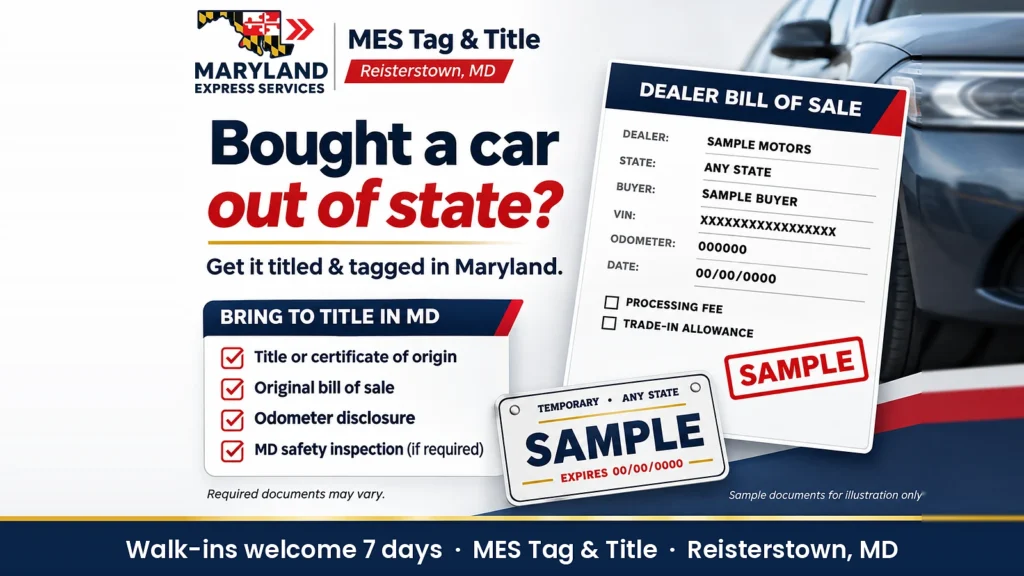
First, confirm whether the selling dealer has already started your Maryland title and registration. If it hasn’t and won’t, the title application is up to you. You can file it with the MVA or through an MVA-authorized tag and title agent like MES Tag & Title. Plan to bring the dealer’s ownership document (a Certificate of Origin, also called an MCO or MSO, for a new vehicle, or the properly assigned title for a used one), the original dealer bill of sale, an odometer disclosure, Maryland insurance information, valid ID, and, for most used vehicles, a Maryland Safety Inspection Certificate. You’ll also pay the Maryland excise tax and title fee. Maryland’s excise tax is separate from any sales tax the dealer’s state collects.
Step 1: Confirm whether the dealer is handling your Maryland title
The MVA’s page on titling a vehicle bought from a dealership says that when you buy in Maryland, the dealer submits the title application for you. If you bought from an out-of-state dealer that doesn’t complete the titling process for you, you’re responsible for it, and the MVA suggests asking the dealer whether the Application for Certificate of Title has already been submitted.
Ask that question before you sign, and again before you come in to title the car. Get the answer in writing. If the dealer says it has started Maryland title and registration processing, ask what it submitted and when, so nothing gets filed or paid twice. Also note the expiration date on any temporary tag the dealer gave you, and plan your Maryland paperwork, and your inspection if the car is used, well before it runs out.
Step 2: Gather your documents
Missing or mismatched dealer paperwork is the most common reason an out-of-state purchase gets held up. Based on the MVA’s dealership-purchase page, the MVA’s Documents Required for Obtaining a Maryland Certificate of Title (VR-005A) and its Title and Registration Manual, bring the following, where they apply to your purchase:
- Title application: a completed Application for Certificate of Title (VR-005), or the MVA’s online Pre-Application
- Original assigned vehicle title or MCO/MSO: for a new vehicle, the manufacturer’s Certificate of Origin (or other ownership documents required by law); for a used vehicle, the properly assigned title, with a complete chain of ownership from the previous owner to each dealer and then to you
- Original dealer bill of sale: VR-005A lists the original dealer’s bill of sale for new vehicles bought out of state and a bill of sale with the assigned title for used ones. The MVA manual says the names on it must match the title or Certificate of Origin
- Odometer disclosure: VR-005A notes that federal and state law require the mileage to be stated when ownership transfers
- Dealer reassignment documents, if any are needed to complete the chain of ownership
- Lienholder information if you financed the car
- Valid identification
- Maryland insurance information: VR-005A says vehicles registered in Maryland must be insured by a company licensed in Maryland, and the MVA manual asks for the company’s full name, the policy or binder number and the agent
- Maryland Safety Inspection Certificate for a used vehicle, unless an exemption applies (see Step 4)
- Trade-in details if you traded a vehicle (see Step 3)
One trap to watch for: the MVA manual says it will reject a transaction if an out-of-state dealer completed the first reassignment on the separate Maryland Dealer’s Reassignment form (VR-182). Out-of-state dealers may reassign on the dealer reassignment section of a Maryland title. If you’re not sure what you’re looking at, our guide to dealer reassignments and bills of sale walks through it, and our tag and title checklist helps you double-check before you come in.
Step 3: Understand Maryland excise tax and the taxable price
Maryland excise tax vs. sales tax paid to another state
These are two different taxes, and it helps to know which one is on your buyer’s order:
- Maryland excise (titling) tax. This is Maryland’s tax, owed when the vehicle is titled in Maryland. If an out-of-state dealer is handling your Maryland title and registration, it may collect this tax to submit with your Maryland paperwork. If yours does, make sure the paperwork labels it as Maryland excise or titling tax, keep your receipt, and confirm the dealer is actually submitting your Maryland title application.
- Sales tax for the dealer’s state. This is a tax paid to another state, not to Maryland. It does not take the place of Maryland’s excise tax when you title the car here.
Under Maryland Transportation Article § 13-809, Maryland’s excise tax is 6.5% of the vehicle’s fair market value, which for a sale by a licensed dealer is the total purchase price certified by the dealer. VR-005A puts it this way: for a vehicle bought from a licensed dealer, the tax is 6.5% of the full purchase price less a trade-in allowance.
Does tax paid to another state count toward Maryland’s excise tax?
Don’t assume it does. Section 13-809(c)(3) gives a credit for sales or excise tax paid to another state only in specific situations: the vehicle was formerly titled and registered in another state, the tax was paid to that state, and the owner has been a Maryland resident for no more than 60 days. The law also sets a $100 minimum tax. That credit is aimed at new residents, which our guide to excise tax when moving to Maryland covers. If you already live in Maryland and buy from an out-of-state dealer, tax collected for the dealer’s state may not reduce what you owe Maryland. Ask the dealer before you sign which tax it is collecting. If another state’s tax was already collected, any refund is up to the dealer and that state, and no refund is guaranteed.
What’s in the taxable price
The MVA’s Taxable Price bulletin explains what dealers may and may not include in the taxable total purchase price. Here’s how it treats the items buyers ask about most:
- Dealer processing (doc) fees: included in the taxable price. The bulletin notes Maryland dealers’ fees are capped at $800. The MVA manual adds that out-of-state dealers’ processing fees are sometimes higher, and the full amount an out-of-state dealer charges is taxable.
- Eligible trade-in allowance: a dealer trade-in allowance is not included, so it reduces the taxable price. To get the deduction, the trade-in has to be documented. Under COMAR 11.15.33.06, that means the Maryland Dealer’s Certification on the title application or an original bill of sale showing the selling price and the trade-in allowance. VR-005A also says buyers from licensed dealers should submit the original bill of sale to ensure the trade-in is properly deducted, unless the Maryland Dealer Tax Certification is completed with the trade-in information.
- Manufacturer rebates: included in the taxable price. A manufacturer’s rebate doesn’t lower the amount Maryland taxes. Dealer discounts or dealer rebates, on the other hand, are not included.
- Down payment: Maryland law, as summarized in the bulletin, gives no allowance for a down payment. Putting more money down doesn’t lower the taxable price.
- Other items: the bulletin also includes shipping or freight and certain after-manufacture items, such as VIN etching. It excludes extended warranties, mechanical repair contracts, federal excise tax, the electronic registration fee and equipment installed to accommodate a person with a disability.
The bulletin is written for Maryland dealers, so ask an out-of-state dealer for an itemized bill of sale that shows each of these items separately. The title fee for a new or used vehicle is $200, per the MVA’s fee schedule. For more on state charges, see how much tag and title costs in Maryland and how Maryland excise tax is calculated.
Step 4: Find out whether you need a Maryland Safety Inspection
New vehicles
A genuinely new vehicle that has never been titled and comes with a manufacturer’s Certificate of Origin (MCO/MSO) generally doesn’t need a Maryland Safety Inspection. The MVA’s Title and Registration Manual says brand-new vehicles aren’t required to be Maryland safety inspected, and that brand-new vehicles must be sold by dealers licensed to sell new vehicles that hold a franchise with the manufacturer. VR-005A lists the inspection requirement under used vehicles.
Never having been titled isn’t the only test. The manual says a demonstrator driven more than 7,500 miles is considered used and must be sold with a Maryland Safety Inspection, even if it has never been titled or registered. If you’re not sure whether your car counts as new, bring the paperwork and we’ll review it with you.
Used vehicles, including certified pre-owned
Used vehicles generally need a Maryland Safety Inspection before permanent registration, unless an exemption applies. VR-005A says used vehicles in the common classes, including passenger cars, multi-purpose vehicles, trucks and motorcycles, must be inspected at an authorized Maryland Safety Inspection Station when they are titled and registered in Maryland. A certified pre-owned (CPO) car is still a used vehicle, so the used-vehicle rules apply. An inspection done for another state’s program doesn’t count, because the MVA’s safety inspection page says it must be done at a station licensed by the Maryland State Police. Once the car passes, the certificate goes to the MVA electronically and is valid for 90 days.
If you can’t register the car until it passes, the MVA says you may qualify for a 30-day temporary registration so you can legally drive it to the inspection station. The MVA fee schedule lists it at $50, and the MVA notes that only one 30-day temporary registration may be issued, so apply when the car is ready to be inspected. Read more in our guides to when a safety inspection is required and Maryland 30-day temporary tags.
Emissions testing is separate. Qualified vehicles are tested every two years, and you’ll get a notice when it’s due. See VEIP after buying a used car.
Step 5: Title and register
With your documents, any required inspection and insurance in hand, you can title and register with the MVA or with an MVA-authorized tag and title agent. If you have plates from a car you sold or traded, you may be able to move them to the new vehicle; our guide on transferring tags to a new car explains who qualifies.
Live in another state and bought the car from a Maryland dealer or seller? That’s a different process; see our 14-day in-transit tag guide.
How MES Tag & Title can help
MES Tag & Title reviews your dealer documents and processes eligible Maryland title and registration transactions. Eligibility depends on the specific transaction. Before you come in, check with the selling dealer whether it has already started Maryland title and registration processing, so nothing is filed twice. At our Reisterstown office, we’ll go over your paperwork with you and point out anything missing before it’s submitted. MES prepares and submits eligible transactions; the MVA processes them and issues titles and registrations, so we can’t guarantee the outcome.
Maryland Express Services provides in-person Tag & Title services. Please bring your required documents to our office for review and assistance. Walk-ins are welcome—no appointment necessary.
MES Tag & Title, 25 Main St Ste C, Reisterstown, MD 21136. Open 7 days. Call, text, or WhatsApp (443) 826-7843. Serving Reisterstown, Owings Mills and Baltimore County.
Frequently asked questions
Will an out-of-state dealer title my car in Maryland?
Some will, but many don’t. The MVA says Maryland dealers submit the title application for you, and if an out-of-state dealer doesn’t complete Maryland titling, you are responsible for it. Ask the dealer whether it has already started Maryland title and registration processing, and get the answer in writing.
Is Maryland excise tax the same as the dealer’s state sales tax?
No. Maryland excise (titling) tax is owed when the vehicle is titled in Maryland. If an out-of-state dealer is handling your Maryland title, it may collect that tax with your paperwork. Sales tax for the dealer’s state is paid to that state and does not take the place of Maryland’s excise tax.
Does Maryland credit sales tax I paid to the dealer’s state?
Don’t assume it does. Under Transportation Article § 13-809(c)(3), the credit applies only when the vehicle was formerly titled and registered in another state and the owner has been a Maryland resident for no more than 60 days. Current residents usually won’t meet those requirements. Any refund of another state’s tax is up to the dealer and that state.
What is included in the taxable price?
Per the MVA’s Taxable Price bulletin, the dealer processing fee and manufacturer rebates are included, and there is no allowance for a down payment. An eligible dealer trade-in allowance is not included, so it lowers the taxable price if it’s properly documented. The full processing fee an out-of-state dealer charges is taxable.
Does a new car bought out of state need a Maryland safety inspection?
Generally not, if it is genuinely new, has never been titled and comes with a manufacturer’s Certificate of Origin. The MVA manual says brand-new vehicles aren’t required to be Maryland safety inspected. A demonstrator driven more than 7,500 miles is considered used.
Does a used or certified pre-owned car need a Maryland safety inspection?
Generally yes. Used vehicles, including certified pre-owned cars, generally need a Maryland Safety Inspection at a station licensed by the Maryland State Police before permanent registration, unless an exemption applies. You may qualify for one 30-day temporary registration to drive the car to the inspection.
What documents should I bring?
Where they apply: the original assigned title or MCO/MSO, the original dealer bill of sale, an odometer disclosure, dealer reassignment documents, lienholder information, valid ID, Maryland insurance information, a Maryland Safety Inspection Certificate for a used vehicle, and the Application for Certificate of Title (VR-005).
Sources
- MVA: Titling a Vehicle Bought From a Dealership
- MVA: Documents Required for Obtaining a Maryland Certificate of Title (VR-005A)
- MVA: Application for Certificate of Title (VR-005)
- MVA bulletin: Taxable Price
- MVA: Interactive Title and Registration Manual
- MVA: Excise Tax
- MVA: Fees & Payment Options
- MVA: Safety Inspections
- MVA: Register a Vehicle (30-day temporary registration)
- Maryland Transportation Article § 13-809 (excise tax)
- COMAR 11.15.33.06 (applying the trade-in allowance)
Maryland Express Services is a privately operated MDOT MVA-authorized Tag & Title agent and is not the Maryland Motor Vehicle Administration. MES does not provide legal advice.