
Shopping for a new plug-in or fuel-cell vehicle? Maryland’s electric vehicle (EV) excise tax credit has funding again for Fiscal Year 2027. The MVA’s October 1, 2026 bulletin reported $2,200,000 in FY2027 credits still available as of that date; that figure is not a current balance and may have changed since. The window for a first Maryland title on a qualifying new vehicle closes before July 1, 2027. Not every EV qualifies, and every credit is subject to eligibility and available funding. We’re Maryland Express Services, a privately operated MDOT MVA-authorized tag and title agent in Reisterstown (not the MVA), and this guide explains who qualifies, what “base purchase price” means, which documents the MVA asks for, and how to apply.
The short answer
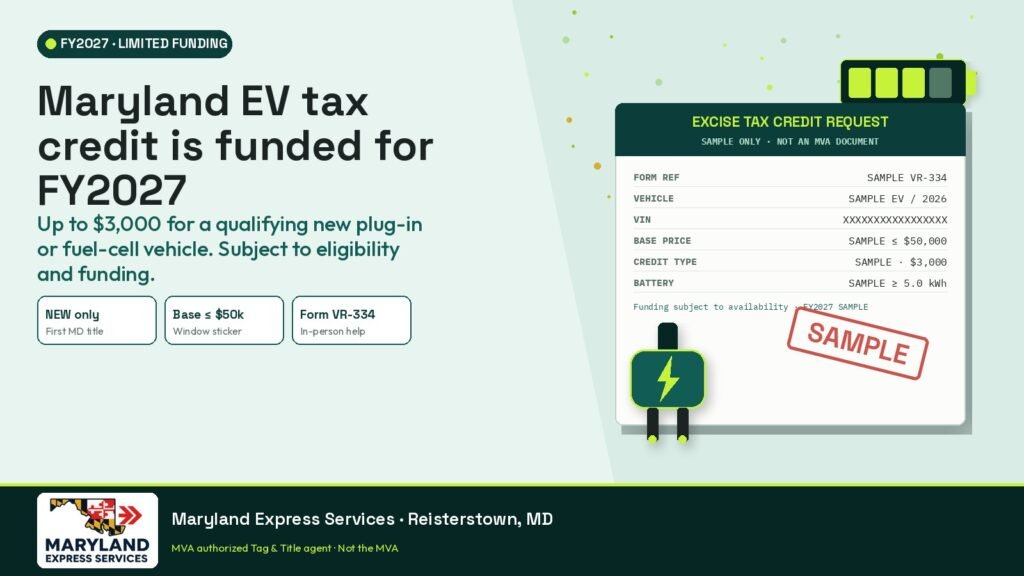
Subject to available funding, Maryland allows an excise tax credit under Transportation Article § 13-815 for a qualifying new zero-emission plug-in electric drive vehicle or fuel cell electric vehicle that is titled for the first time on or after July 1, 2023 and before July 1, 2027. Credit amounts on the statute and on Form VR-334 are:
- $3,000 for a zero-emission plug-in EV or fuel-cell motor vehicle
- $1,000 for a two-wheeled zero-emission electric motorcycle
- $2,000 for a three-wheeled zero-emission electric motorcycle or autocycle
The vehicle must be registered in Maryland, have a base purchase price of $50,000 or less (the prominent window-sticker base price before options), and meet the battery and speed rules below. The selling dealer may submit through the MVA dealer portal, and customers may submit directly to the MVA by email or mail (FY2027 funding bulletin). Used EVs do not qualify, and a refund is not guaranteed.
Why FY2027 matters (and what happened in FY2026)
Maryland’s Clean Cars program funds this credit year by year. An MVA bulletin dated August 12, 2025 reported that Fiscal Year 2026 funding was depleted; applications were still accepted and placed on a waiting list (FY2026 no-funding bulletin). The MVA’s October 1, 2026 bulletin reported that FY2027 funding is available, with $2,200,000 in credits still available as of October 1, 2026. Check the latest MVA bulletin before you buy. VR-334 says credit requests are processed “subject to funding availability,” and § 13-815 makes the credit subject to available funding.
Who qualifies
Both the statute and VR-334 (revision 7-23) list the same core conditions. A vehicle generally needs to:
- Be purchased new and titled for the first time on or after July 1, 2023, but before July 1, 2027
- Be acquired for use or lease, not for resale
- Not be modified from original manufacturer specifications
- Have a base purchase price not exceeding $50,000
- Have a maximum speed of at least 55 mph
- Be registered in Maryland
- For a zero-emission plug-in electric drive motor vehicle, have a battery capacity of at least 5.0 kWh (VR-334; statute § 13-815(b)(1)(iv))
- For a motorcycle or autocycle, have a battery capacity of at least 4.0 kWh (VR-334)
- Fuel-cell vehicles follow the parallel rules in § 13-815(b)(2) (new, first titled in the window, base price ≤ $50,000, use/lease, not modified)
Limits under § 13-815(e): one vehicle per individual and 10 vehicles per business entity. Joint owners who each qualify can each claim a credit on one of two jointly owned qualifying vehicles (VR-334 certification language).
Base price is not your “out-the-door” price
VR-334 is clear: “The Base Purchase Price for the vehicle is the prominent price displayed on the window sticker of the vehicle. The base purchase price is the price before options and does not include optional upgrades, shipping charges, taxes, fees, or calculation of a trade-in allowance.” A car with a $48,000 base sticker and $6,000 in options can still qualify on price; a $52,000 base sticker does not, even if a rebate or trade brings the amount you finance lower.
What documents the MVA wants
The FY2027 bulletin lists four items:
- Completed VR-334: Excise Tax Credit Request for Plug-In Electric Vehicle
- A copy or image of the Monroney / window sticker
- A copy of the bill of sale
- A copy of the Manufacturer’s Certificate of Origin
VR-334 also has a section the dealership completes: battery capacity in kilowatt hours (or that the vehicle is a fuel cell vehicle), date of sale, base price, and confirmation that the Monroney sticker is attached. Customers who apply themselves send the same documents.
How to apply
Through your dealer (preferred)
The selling dealer may submit the application and supporting documents through the MVA dealer portal, which the MVA’s bulletin calls the most efficient way to submit. If the dealer submits through the portal, the customer does not need to submit another application.
By email or mail (customers)
Customers may also submit the application and required documents directly to the MVA by email or U.S. mail, using the email address and mailing instructions printed on Form VR-334 and described in the FY2027 funding bulletin. The bulletin notes that email or mail may delay receipt and processing compared with the dealer portal, and it says customers can expect a refund check about 4–6 weeks after the MVA receives all required documents. Timing is set by the MVA and is not guaranteed.
What a tag and title agent can (and can’t) do
Maryland Express Services provides in-person assistance with understanding the eligibility requirements and preparing the necessary paperwork. At our office we can go over the credit rules with you, check that your window-sticker base price and documents line up with what VR-334 asks for, and handle your Maryland title and registration for the new vehicle.
MES does not submit, process, approve or guarantee EV excise tax credit applications. The MVA’s public instructions describe two submission paths: the selling dealer through the dealer portal, or the customer directly to the MVA by email or mail. The MVA reviews applications, determines eligibility, tracks funding and issues refunds.
Maryland Express Services provides in-person Tag & Title services. Please bring your required documents to our office for review and assistance. Walk-ins are welcome—no appointment necessary. We do not accept document uploads or document submissions through our website. See our tag and title services page.
How this credit fits with Maryland excise tax
Maryland’s vehicle excise tax is separate from the federal tax picture. The credit under § 13-815 is an excise tax credit administered by the MVA for qualifying clean vehicles — not a reduction we invent at the counter. For how Maryland calculates excise tax in general, see our guides to Maryland vehicle excise tax calculation and tag and title state fees. Moving here with a car you already own is a different topic: excise tax when moving from out of state.
If you’re titling a new car and transferring plates, start with transferring tags to a new car and our Maryland tag and title checklist. MES service fees for title and registration work are listed on our Service Fees page and explained in our transparent pricing post. This article does not quote MES prices for the EV credit itself, because the credit is an MVA refund program — not an MES product.
Common pitfalls
- Used or previously titled EVs: do not qualify. The vehicle must be purchased new and first titled in the statutory window.
- Base price over $50,000: measured on the window-sticker base, not the negotiated “deal” after options and incentives.
- Waiting too long: first title must occur before July 1, 2027, and funding can run out earlier (as FY2026 showed).
- Assuming every EV qualifies: the vehicle must meet every condition on VR-334, and approval is up to the MVA.
- Assuming the dealer filed: ask your dealer whether it submitted through the portal; if not, you can submit directly to the MVA by email or mail.
- Skipping Maryland registration: § 13-815(f) says a credit may not be claimed unless the vehicle is registered in the State.
- Already claimed your one individual credit: the limit is one vehicle per individual (10 per business).
How Maryland Express Services can help
Maryland Express Services provides in-person Tag & Title services. Please bring your required documents to our office for review and assistance. Walk-ins are welcome—no appointment necessary. We’re at 25 Main St Ste C, Reisterstown, MD 21136, close to Owings Mills, Glyndon and the rest of Baltimore County. Hours: Monday–Friday 9 AM–9 PM, Saturday 9:30 AM–8 PM, Sunday 10 AM–7 PM. Call, text, or WhatsApp (443) 826-7843, or contact us.
For the EV excise tax credit, we provide in-person assistance with understanding eligibility requirements and preparing the necessary paperwork. We do not submit, process, approve or guarantee credit applications. The selling dealer may submit through the dealer portal, or you may submit directly to the MVA by email or mail. For title and registration, the MVA reviews, processes and approves applicable transactions. Eligibility, funding and refunds are decided by the MVA.
Frequently asked questions
Is Maryland’s EV excise tax credit available in FY2027?
The MVA’s October 1, 2026 bulletin reported that Fiscal Year 2027 funding is available, with $2,200,000 in credits still available as of October 1, 2026. That is not a current balance. Credits are subject to eligibility and available funding, so check the latest MVA bulletin before you rely on the credit.
How much is the Maryland EV tax credit?
Subject to funding, the credit is $3,000 for a qualifying zero-emission plug-in EV or fuel-cell motor vehicle, $1,000 for a two-wheeled electric motorcycle, and $2,000 for a three-wheeled electric motorcycle or autocycle, under Transportation Article § 13-815 and Form VR-334.
Do used electric cars qualify?
No. The vehicle must be purchased new and titled for the first time on or after July 1, 2023 and before July 1, 2027.
Does every electric vehicle qualify?
No. The vehicle must be purchased new, first titled before July 1, 2027, have a base price of $50,000 or less, meet the battery and 55 mph speed rules, and be registered in Maryland. Credits are subject to MVA review and available funding, and a refund is not guaranteed.
What does “base purchase price” mean for the $50,000 limit?
VR-334 says the base purchase price is the prominent price on the window (Monroney) sticker before options. It does not include optional upgrades, shipping, taxes, fees or a trade-in allowance.
How do I apply for the Maryland EV excise tax credit?
The selling dealer may submit VR-334, the window sticker, bill of sale and Manufacturer’s Certificate of Origin through the MVA dealer portal. Customers may also submit directly to the MVA by email or mail, following the instructions on Form VR-334 and the MVA’s FY2027 bulletin. The MVA decides eligibility and issues any refund.
Can a tag and title agent submit my EV credit for me?
Maryland Express Services does not submit, process, approve or guarantee EV credit applications. We provide in-person assistance with understanding eligibility requirements and preparing the necessary paperwork. The selling dealer may submit through the dealer portal, or you may submit directly to the MVA by email or mail.
Is there a limit on how many credits I can claim?
Yes. The statute limits the credit to one vehicle per individual and 10 vehicles per business entity. The vehicle must also be registered in Maryland.
When does the credit window end?
Eligible vehicles must be purchased new and titled for the first time before July 1, 2027, and the credit is always subject to available funding. Funding can be exhausted before that date.
Sources
- MVA: Excise Tax Credit for Plug-in Electric or Fuel Cell Vehicles for Fiscal Year 2027 Funding (Oct 1, 2026)
- MVA: Excise Tax Credit – No More Fiscal Year 2026 Funding (Aug 12, 2025)
- MVA Form VR-334: Excise Tax Credit Request For Plug-In Electric Vehicle
- Maryland Transportation Article § 13-815 (PDF)
- Maryland Transportation Article § 13-815 (statute text)
- MVA fees and payment options
Maryland Express Services is a privately operated MDOT MVA-authorized Tag & Title agent and is not the Maryland Motor Vehicle Administration. MES does not provide legal advice.